Episode Transcript
[00:00:00] Speaker A: Most of us don't ever even have time that we spend with ourselves in our own thoughts. If we're alone, we find a way to distract ourselves, either with screen or substance of some sort. And so a writing practice where you're able to clarify your own thinking better, articulate what it is that you believe is not only incredibly therapeutic, but it's a way to stand out in this sea of sameness.
[00:00:25] Speaker B: I'm Diana Earley, and I've spent most of my life learning firsthand what privilege actually costs.
The legacy control, the family expectations. The guilt of feeling trapped in a life everyone thinks you should be grateful for. If you've ever wondered why having everything still feels like something's missing, you're in the right place.
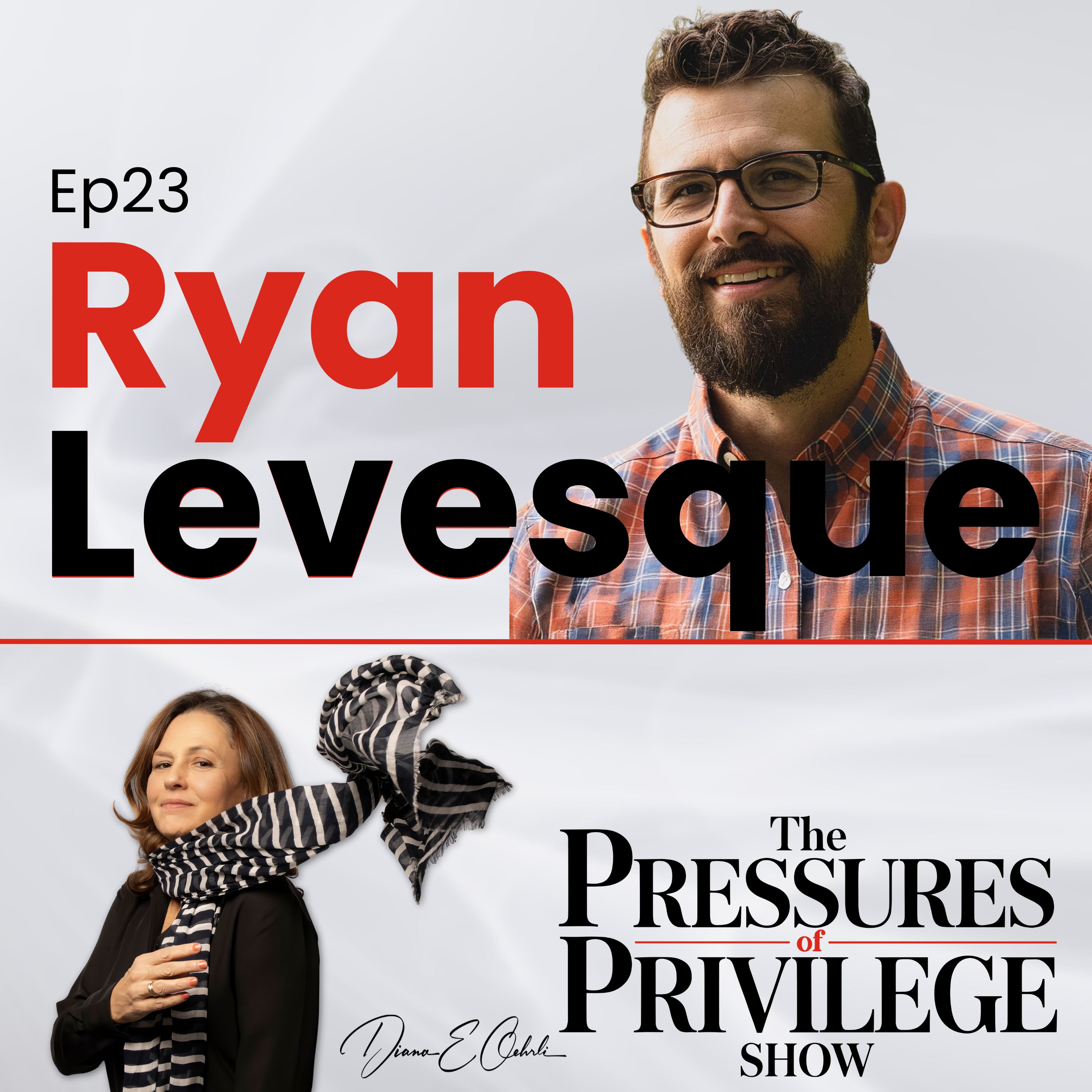
Welcome to pressures of privilege, everybody. Ryan Levesque has a touch earth before touching a screen.
I love that you. He's built companies that generated over 100 million. He's landed on the Inc. 5000 list seven times. He's written two number one best selling books. More than 100,000 people read his weekly newsletter, the Digital Contrarian. And then he moved his family to a farm in Vermont. I first met Ryan at an investment club in Boston. From the moment he spoke, I knew he was different. Clear, direct, no bs. He became a mentor to me, shaping how I think about business and life when it came to my writing. He encouraged me to take my skeletons out of the closet and make them dance.
Ryan calls this moment an inflection point where AI, automation, and algorithms are changing everything.
His answer, return to real.
In a world of artificial everything, he believes authenticity is the only advantage left. Please join me in giving a very warm welcome to Ryan Lubeck.
[00:01:49] Speaker A: That's amazing. I'm so. I'm blushing right now. Really grateful for the opportunity and excited for this chat here today.
[00:01:57] Speaker B: I'm really excited, too. Thank you. Ryan, I think people are probably curious to know your story. I mean, some people probably know it already, but you.
[00:02:03] Speaker A: You.
[00:02:04] Speaker B: You almost died at 30. How did that change your. Your relationship with success?
[00:02:09] Speaker A: So when I turned 30 years old, my first son was born, and my wife asked me to apply for life insurance as a. As a, you know, dad with a life that I was responsible for.
And at the time, I was. I was running my company, I was working really, really hard, and I was not taking care of myself.
I applied for life insurance, and the life insurance application came back denied.
And it came back denied because I learned my lab results were literally off the charts. I literally got a phone call from the life insurance agent who Said, I have your lab results. I'm not a doctor, I'm going to give them to you. I think you need to go see a doctor. And so I, I looked at the lab results and I did the big. I made the biggest mistake of my life at the time, which is I went to Google to see what they meant.
And what came back was kidney failure, pancreatic cancer and renal system shutdown. Like my heart just sank. And so that night, I remember I told my wife what had happened and I, because she had asked me about the, the status of the life insurance, because we got a letter in the mail and I told her what the numbers are, she broke down. She immediately said, we have to go to the doctors first thing in the morning. Called the ask a nurse hotline, went into the doctors the next day. Go to the doctors, explain what happened. And in my mind at this time, Diana, I thought my lab results were mixed up with somebody else's. Like that was the story that I had in my head. It was like someone else's lab results got mixed up with mine. A 30 year old male. This should not be happening to me. Explain this to the doctor. And he says, okay, we'll order some blood work. Stay in the waiting room, we'll order it stat. I'll be right back out. Comes back out about, I don't know, 45 minutes. An hour later, grabs me by the shoulders and he says, Mr. Lebec, you should be in a coma right now. We have to rush you to the emergency room. So they rushed me to the emergency room and I learned that I was in a state known as dka, diabetic ketoacidosis. And my organs were shutting down.
And effectively I was an undiagnosed type 1 diabetic. I had an autoimmune response that attacked my, my pancreas and my pancreas was, had shut down and my whole body, as a result, was beginning to fail. And I later learned that if I had gone maybe another 24 hours, that I probably would have slipped into a coma and possibly died. Wow. And it's just crazy. Like, you know, the universe nudging you in these ways like we were just talking about before coming on, on the air like this, that, like there are these, these signals, you know, why was it that at that time my wife said, I think you should apply for life insurance? Like, why didn't she have that instinct at that moment in time, which ultimately was the thing that probably saved my life. You know, I was running a very fast growing company at the time, I was burning the candle on both ends. I had all the symptoms in retrospect, like I was tired all the time, I was thirsty all the time, and I had to pee three, four times in the middle of the night. And I have, I was in this like vicious cycle where the story I told myself was, oh, I'm a New Englander, like a kid from New Hampshire who grew up in the White Mountains of New Hampshire where it's very cold, who married a Texan and was in Texas in this 110 degree heat. And I couldn't handle the temperature, so I was thirsty all the time. So I'm drinking all this water and because I'm drinking all this water, I'm getting up to pee three times in the middle of the night. And because I'm getting up to pee three times in the middle of the night, I'm tired. And every day. That was like the story that I told myself. That's what I thought, what was going on?
Turns out, you know, my body was basically shutting down. You know, at that time I went to the, I was rushed to the emergency room and I spent over a week in icu and I was next to a dialysis patient, like an elderly dialysis patient. I remember thinking myself a six month old baby at home who could not visit me. I'm in the hospital, I'm in ico.
What did I do to my body? Like, why did I push myself as hard as I did? And what changes do I need to make? Cause I don't want my son to grow up without a dad. I, I don't want my wife to grow up, you know, to grow old without a husband. I need to make some real changes in my life. And that was a turning point for me. That was a moment in time that, that shifted the direction of my life.
[00:06:13] Speaker B: Wow.
And how has it shifted?
[00:06:16] Speaker A: I put health at the forefront of my life. I mean, like it's the old adage, right? It's the man who has his health wants for everything. The man who doesn't have his health only wants for one thing. That was definitely the, the, the, the way that I had felt. I had built a successful consulting practice. I had 20.
My model at the time was a partnership model where I worked with client partners and I was paid on a revenue share and royalty basis on the work that we did together. So I kind of had my hands in 20 ish different businesses and was a minority partner effectively in these businesses. It was just too much like, I mean, I had every single week I had 23 one on one calls without fail in 23 different businesses. And I'm solving problems in all these different businesses, all these different markets. And I was just torn in all these different directions. So I decided I couldn't do that. Like that was not sustainable, it was not scalable. So I basically told my clients like I'm, I'm no longer going to be doing what I'm doing except for a very small handful that I had retained.
And I thought I need to find more leverage in what I'm doing.
And I just felt this instinct to teach.
I'd always enjoyed teaching. I taught a section of neuroscience in college. I taught a section of biology in CL in college. So I really enjoyed teaching, teaching and I was, and I thought I was pretty good at it. Like I thought I just based on the evidence I had the largest section in Neuro1 at Brown. Like it just if my section would grow because I kind of had a reputation as oh, he can explain the complicated things. That professor is not being able to like explain clearly. So I just kind of had this natural talent around that and I thought well, what if I shift my business from doing and executing this model that I developed in all these different markets to teaching this model instead of.
And that's what inspired me to write my first book Ask, which went on to become the number one national best selling book in the country the week that it launched. Ironically, it launched the same week as Malcolm Gladwell's book David and Goliath. And we landed at, I landed at number one and he landed at number two. Which was like pretty cool because I was the David and he was the Goliath like in that story. So I, it's just I always love telling that story and Malcolm Gladwell is like I'm a huge fan of his work. So it was like just know an honor. The, the point with that is that the, the book took off in a way that I never expected. Like I just felt like compelled to write this book to tell my story and to share this methodology that I developed that we were executing in all these different markets. And then that book really served as the lead domino to build an entire company around this model. A training and education company. And then we built a software company. Basically the technology to execute this model. The better part of a decade of just a rocket ship of growth, but doing it in a way that was far more sustainable where health was at the forefront of everything that was important.
[00:09:10] Speaker B: So you created Bucket after that experience.
[00:09:14] Speaker A: That medical experience, the sequence of Events was I wrote this, I wrote the book Ask became number one national bestseller.
Generated a ton of inbound demand from people who wanted to learn this methodology and execute this methodology. So that led us to build a training and education company around that.
In the training and education company, the biggest gap that existed was there was no form of technology on the market to execute what it is that we were teaching. You know, yes, you could hire a team of developers and you could custom develop and custom build something, but there wasn't something that was available for a more mainstream business audience.
So we thought, well, if there's nothing that exists, what if we build it? And that led us to build the software company. We, you know, we pre launched that software and I think we had, you know, with one email we had over a thousand people sign up for the software. I mean it was just like, you know, kind of this explosion and then we built that company and then in 2024 was fortunate enough to exit out of that business. And that was around the same time, a little bit after we moved our family from the suburbs of Austin, Texas to the Green mountains of Vermont, where we now live on a 100 acre regenerative farm where we raise and grow our own food.
Where again, health is at the kind of the forefront of the rationale and reasoning behind that.
[00:10:36] Speaker B: Yeah, it's such a huge pivot because if you think of your background, like from Goldman Sachs to farming, this is.
[00:10:43] Speaker A: Not on my bingo card. Like, I never thought I was a going to move back to New England when I left New England, grew up in New England and then went to college in New England and then moved to New York City, worked on Wall street, worked for Goldman, and then had an opportunity to live and work in Asia. And I was working in finance in Shanghai. We were there for about five years and then when we moved back, we kind of had a spin the globe moment and we thought, oh, Texas would be a great place to, to, to live. And my wife's family's from Texas, so we did that and we were there for almost 14 years. I never in this journey ever thought I was moving back to New England. Like ever, ever, ever, ever. You know, the universe has this interesting way of just kind of nudging you in different directions and if you pay attention to these clues, then you'll often find, you know, there's a, there's a story there. The, the thing that I think is really funny is when I was 12 years old, I convinced all my parents to till basically most of the yard that we had in the, the house that I grew up in and transform it into a vegetable garden. And I just had this vision as a 12 year old kid that I wanted to create this vegetable garden and do it all organically and you know, do the whole thing. My dad, when he was 40 years old, bought a rototiller, like a hand powered rototiller to, to, to till the garden.
My parents save everything. Like they, they're the people who like nothing ever gets like thrown away.
Fast forward to 2022 when we moved to Vermont. My dad, as we're building our big garden out here, like we have a, almost an acre that's, that's just a vegetable garden. And he said, hey, would you like to borrow or have like the rototiller? I still have it. And so my parents bring it up to use it and in the, in the box with like the manuals and you know, the paperwork with the rototiller was a receipt from Home Depot. This is crazy. I have this receipt. It's faded, but you can still read the ink on it. My dad bought this rototiller when he was 40 years old.
The exact same week in his age that I bought our farm.
Wow, like to the week.
[00:12:54] Speaker B: That's crazy.
[00:12:54] Speaker A: Yeah, it was just one of these moments and like, you know, I didn't know that. It was just in my head. It was like just this cosmic connection of like it happened. You know, that vegetable garden happened when my dad turned 40 and then this farm happened when I turned 40. There was something there. I don't know what it is, but like this, this, this thread was there and it kind of segues nicely into what you brought up about this idea of, you know, in an age of artificial everything, what if real is the, the only advantage left.
And I think there is a certain level of biological wisdom that we have innately that is dormant in much of the world because we spend so much of our time in a, in a man made world. You know, more time with man made things than we do with God made things.
And, and we're, we're connected to the natural world. We're connected to each other in ways that I think much of the world doesn't feel because so much of the world that we experience is, is through an abstracted experience, through the screens that dominate our lives. I mean, you know, it would be great if you and I were, were in the Alps together or in the, the green mountains of Vermont. We're doing this together in person. This is like the next best thing but think about how much of our lives now is through proxy. It's through abstraction and experienced through this, this very tiny little window of a screen that connects us to the world. Anyways, I'll pause there. It's a long answer to a short question, but I think that it's a good segue into, you know, this idea of. In a world of artificial everything, what is the last advantage left, the last human advantage that we may have left in this era that we find ourselves in right now?
[00:14:42] Speaker B: Well, we were talking about your turning 40 and your dad buying you that rototiller and you buying the farm, right? When at, at the same age your dad was when he bought you the rototiller. I mean, that's the same. That's what we call synchronicity, or totally. And I think synchronicity can only really happen in the world of real.
[00:15:00] Speaker A: There's some spin off ideas around this, right? So one is we find ourselves in this era now where.
And we, we can take this conversation in a million different directions. But, but one of the directions that, that shows up is it's, it's never been easier to get into the game, but it's never been harder to stand out.
Meaning if you've got a podcast or a platform or a message that you want to get out into the world.
We are drowning in a sea of sameness right now. And part of it has to do with just the way technically large language models and AI generated content operates, in the sense that it's a predictive model that what is the next most average or obvious word in this string of sentences. And so we have this sort of AI generated pablum that we're all drowning in right now that is a shade of beige. It's like the beige of occasion, of, of everything that we're consuming. And so what's lost is the fact that every unique human has a, a unique energy signature.
And we have. And I mean, I'm, I'm not going to be woo woo about it, but it's true. Like this is scientifically proven. We have an energy field that extends beyond like where our skin meets the atmosphere. It extends beyond us animals repeatedly, dogs, cats, studies over and over again have been able to, and this has been replicated many, many times, that if you have an animal that you have a connection with, certain animals will change their behavior when out of sight, out of sound, out of smell, you've made a move to start traveling home.
So like, they will change, like their physiology will actually change. How is that connection, like, where does that connection exist now? That's between dogs and humans. What about humans to humans? Like, there's a reason why we feel a certain way when we are deeply connected with someone and it doesn't happen through a screen. One of the things that I talk about in, in, in my, my next book, Return to Real, is the fact that much of the modern maladies of life, and this is, ties into a lot of your work as well.
The loneliness epidemic, the sense of isolation, the sense of disconnection that we feel, the dissatisfaction that exists, the addiction that we have in terms of state management through screens and substance, as opposed to state management through ourselves, stems from the fact that we are experiencing right now what I describe as a global oxytocin deficit. Meaning if we look at the neurochemicals in our, in our brain and the role that they play, there's a neurochemical that's gotten all the headlines in the last decade. And that neurochemical is dopamine. Right? You know, it's like everything's about dopamine. You know, we, the, the, the apps that we use, the social media that we scroll. It's all that hacking, dopamine and that dopamine response. We are drowning in cheap dopamine.
But I believe the neurotransmitter of the next decade that's far more important than dopamine is oxytocin. And oxytocin is the neurotransmitter of trust. It's the neurotransmitter of love. Why this is relevant to this conversation here is dopamine is something that's easily hacked through a screen. But oxytocin, just the way in which it's elicited in the brain and thus in, in the body, requires physical presence. It requires touch, physical touch that exists. It's not impossible, but extremely difficult to experience oxytocin when all of your relationships are through FaceTime and through Zoom meetings. It has to happen in person.
And we live in a world now where you don't need physical contact. Like, we live in a world where we have contactless convenience that is a feature of many products. You don't have to go to the restaurant anymore to actually interact. You can just have ubereats drop the food off at your doorstep. Um, you don't have to go to the store to do any shopping and interact with the, the store clerk. You can just go to Amazon prime and have a box of stuff dropped at your doorstep. You don't have to go to the movies anymore or go to the play or go out for entertainment. You have a million billion options with streaming services that are right there at your fingertips. I mean, you could literally get all of this without leaving home. And the reality is that this convenience is killing us. This convenience that we are optimizing for in the name of efficiency and ease is actually killing us.
And there's so much evidence around this, you know, in the United States, going into your world of longevity. I think life expectancy in the United States peaked what, five years ago, six, seven years ago, something like that. Like it is. We have not been able to bypass that despite advances in modern medicine, increased spending in healthcare.
And I wonder with AI and our dependency on this technology, if we're going to see in a few years that not just life expectancy but intelligence as measured by IQ is going to be the next thing that we will have seen peak. And so we are in this interesting decline phase where the conveniences of modern life driven by abstraction, proxy experience is actually making us worse off as opposed to better off. And with all this evidence, the question is, okay, well, what do we do about it? Like, what's the, what are the moves that we can make? Like how do, what are the shifts that we can make? And then you've got your, your pillars of health and, and I have principles that I've, I've kind of, as I've pulled on this string that I've identified as perhaps candidates that we should consider.
[00:20:29] Speaker B: Well, in your book ask you, you talk about the whole. Improving your SAT scores was something that stood out. How you just practiced and you practiced over and over and over and over again until you had a score that you knew would be high enough that when you took the real test it would be, you know, where you wanted to be.
[00:20:47] Speaker A: Right.
[00:20:48] Speaker B: I just, that really stood out to me because, you know, I just, you know, my own experience, I just took the test. I never practiced. No wonder I didn't do very well. I just thought it was dumb, but I just thought, oh, he practiced sort of the way I practice the piano. You just keep practicing that thing over and over again until it gets good.
And it reminds me of, you know, what I just wrote about, about like how we need more friction in our lives and this sort of anti fragility aspect of life.
I think living on a farm, I mean, I'm, I'm living here in Swiss Alps surrounded by farmers. Their tractors are getting a little bigger, but in general their lives are pretty full of friction. You know, they're not, it's not a convenience type of lifestyle, and they're happy.
[00:21:29] Speaker A: I wrote a piece that I titled the Struggle is the Solution.
And, and we want to erase struggle from our lives. We want to take it out and we do it because we think it's actually going to us happier. The data suggests otherwise. To your point, the data suggests that when you have forms of friction in your life, when there is physical struggle. So one of the principles that I, that I write about in the book is there's tremendous evidence that suggests that we need to rewild, to reconnect meaning by putting ourselves in nature. And this is not just like sitting in nature and, you know, looking at the scenery around us. It is hands in the dirt. It is actually, you know, doing hard things immersed in nature is a fix for so much of what we're describing right now. I mean, just the evidence is overwhelming if you want a business rationale for why you should do this. Innovation and creativity skyrockets when you spend as little as 15 minutes in a natural setting like that doing hard, hard things. Just the, the neurochemical cascade that gets released from endorphins to serotonin when you're in nature. That is what we're missing in, in much of modern life.
The, the actual physical contact, the biology, how it helps us when we are literally getting our hands in the dirt, and the positive bacteria that, that introduces into our body and eventually into our gut, which then just regulates everything from our mood to our, our hormones to just everything. There's so much evidence that suggests that the answer is actually fairly easy. But the problem is we're conditioned to find abstractions for that instead of actually touching earth before touching a screen and physically grounding by being barefoot in the ground. Instead, what we do is we buy a grounding mat off Amazon prime and stick it under our desk and say, I'm going to ground using this.
I had someone that asked me the other day when I was delivering a keynote and I was talking about oxytocin and the role that it plays in, in our, in our body and, and why many people are just lacking oxytocin. And the question that he asked me after the talk, which is so telling, he said, can I, like, is there a supplement that I can take to like, just give me like, oxytocin? Like, is there, what do I take to like, get this? I'm like, no, that's not, that's not it. Like, it's, it, it, it requires, like, you do need to do these things.
So to your point, about friction.
[00:23:55] Speaker B: Right. I mean, he could breastfeed if he could.
[00:23:57] Speaker A: No, yeah, exactly. Yeah, yeah, exactly. Give birth.
You know, that's. That's the real answer. Give birth. That's the highest.
Yeah, that is the highest concentration of oxytocin. Is a, Is a. As a mother with her, her newborn baby, just the flood of oxytocin is what creates that, you know, feeling of unconditional love and just obviously never been a mother, but, you know, any mother can, can attest to. So to your point. Yeah, the struggle is the solution. As I. As counterintuitive as this is, we can get freedom through friction.
[00:24:31] Speaker B: A lot of my viewers and readers are wealthy people.
So how can we convince my friends who are wealthy and my readers that the struggle is where it's at? They're into looking for convenience and things that feel good. They're not looking for making life harder.
[00:24:48] Speaker A: Yeah, well, what I would say is this. Look, if you're, if what you're doing is working, just keep doing that. But if it ain't working, you know, we all know the definition of insanity, right? It's doing the same thing, expecting a different result. You know, for me, the moment of awakening, it's happened at a few points in my life. But the turning point for me was when we took our company to market. To sell. To sell a business. First time that we brought the company to market, we brought it to market. We had multiple offers, ended up going deep with one of the private equity groups. That was interesting in buying a business.
And between taking the business to market and going through diligence, we spent almost a year in process.
The company, the PE firm that was looking to buy a business, spent over a million dollars in diligence. We got that deal to the one yard line before the deal fell apart. And the deal fell apart largely due to macroeconomic forces. This was 21 into 22, fourth quarter of 22, and this is when Russia invaded the UKRA.
Markets crashed and interest rates spiked. And there's just all these macroeconomic headwinds that kind of dried up the M and A market. And I just had this feeling that I missed the window to sell the company. Like, I just had this, like, I just spent 10 years on this decade long sprint. This is not how the story was supposed to end. And because of that, I just needed to take a step back. Like, I just wasn't prepared to just like, all right, dust myself off and let's go another, you know, 10 years up the mountain. I decided to take some time off and and it was over the summer, when our kids were away at summer camp, that I had this serendipitous opportunity to do a permaculture design certification in, on a farm in the Mad River Valley of Vermont. And it meant living in a tent primitively on this farm. I didn't have a whole lot of time to make a decision. There was a spot that opened up at the last minute and within two weeks I was on an airplane flying to Vermont, spending a summer on this farm to learn regenerative farming and permaculture. Basically, you know, living in a tent and bathing in a pond. And it was my, it was my Walden moment. Like, it was my Walden moment throws Walden moment for me. And it was where I knew that in my heart, like, this is how not living in a tents, bathing in a pond, but being deeply connected to nature. This is what I was craving. This is what my body was craving. This is what my biology was craving. And you know, coming from a concrete jungle and, you know, glass buildings and Silicon Valley south in Austin, Texas to this was just two very different places. And I'd spend most of my life living in big urban environments other than Manhattan. I lived in Shanghai, I lived in Hong Kong, and then later Austin, Texas. And so this wasn't something that was like in my life, like my entire life. But I felt this craving and I just kept listening to my body saying, this is where you're meant to be. It was not on my, not in my plans, it was not on my bingo card, but it was there that it felt this calling.
So to someone who's of means, I was in a position when I was on this farm that I, you know, could have, should have been at the Four Seasons, like down the road. Like, that's how I should have been doing the experience. Right. But I just surrendered to that. And so for anybody who's kind of been in this convenience paradigm, what I would encourage you to do is run an experiment. Just try it out. Like, don't commit for the rest of your. Of your life. This is not a, an advocation to follow the path that I've followed. It's an advocation to pull on the string to help identify what is real for you.
Like, what does this look like for you? You know, for me, it was very much food focused. I wanted to get to a place where we're eating as a family, real food that I knew exactly where it was sourced from and how it was being raised and how it was being grown. That was kind of like the first you know, lead piece that drew me down this path eventually brought us to the, you know, to the site that we're on right now where we raise and grow about 80% of the food that we eat as a, as a family. I was just trusting what I describe as the contrarian voice of my heart. I was listening to the contrarian voice of my heart and not, you know, trying to follow any prescribed path, but just sort of what was my body, my physiology, what was my heart telling me was, was what I needed.
So, you know, for someone of means, if you're happy, by all means, like just, you know, don't listen to this crazy guy with a beard in Vermont, like to do anything. But if, but if you feel like something's missing, maybe it is that the pendulum has swung too far on the convenience side of the equation. What you actually need is hands in the dirt.
[00:29:19] Speaker B: So I'm just thinking of other things besides food production that could be sort of in parallel to what you're doing.
[00:29:25] Speaker A: What are some examples? I've got a colleague of mine, a good friend of mine who was a former technologist, built a technology business and he just felt this desire to be in the mountains. So he just started making more and more space to hike.
Last year he did seven 14,000 foot peaks in Colorado. He's going to do 10 more this year. That's what it looks like for him now. He is taking people on these journeys like it was not again, it was not something that he had had in his plans. He's just trusting that contrarian voice in his heart and he knows that the time that he spends on the mountain is sacred. I've got another friend of mine who built a very successful travel company and wasn't doing much travel of his own in building this travel company and decided that he's going to start taking high net worth individuals and entrepreneurs to far off destinations in corners of the world that most people never even get a chance to see.
You know, going to hiking in Patagonia, hiking in Inner Mongolia, being around herdsmen in Inner Mongolia and living among them for weeks as you hike through the plateau.
And you know, these are parts of the world that most people never get to see. Like this is not. There's no Ritz Carlton or four seasons down the road that you can stay at and you know, spend five minutes, you know, kind of taking photos, taking photos to, to prove that you were there. This is actually living the experience.
So, you know, I think it's finding that version of what that looks like for you now, that's not the only path, like, for reconnecting, you know, hands in the dirt is one of the principles that I talk about in, in this next book. We talked a little bit about oxytocin and what I describe as heart, humor and humanity and optimizing for oxytocin, as opposed to optimizing for dopamine, which is what most of our lives are optimized around is, is cheap dopamine. I also believe, and this is a practice that you've involved into your life is what I describe as seek and speak truth, meaning to trust that contrarian voice in your heart and to adopt a writing practice or a communication practice where you're actually getting in touch with what it is that you believe. Most of us don't ever even have time that we spend with ourselves in our own thoughts.
If we're alone, we find a way to distract ourselves either with screen or substance of some sort. We don't actually ever sit with our own thoughts. And so a writing practice where you're able to clarify your own thinking better, articulate what it is that you believe is not only incredibly therapeutic, but it's a way to stand out in this sea of sameness where your energy signature, as we described earlier, where your voice actually comes out in a way that sets you apart in a distinct way that separates you from everything else that's out there in the world.
[00:32:18] Speaker B: You know, you talked about that period of time when you were in the tent and bathing in the pond. Have you, have you recreated that moment?
[00:32:26] Speaker A: Yes and no.
So my boys every year love camping in front of our ponds here on our farm. So, like, that's one of their favorite things in the world to do, is that we'll like do a campfire, we'll eat out there. We don't need to go, you know, hundreds of miles in some far off destination. We literally just camp by the pond, which is a few hundred feet from our farmhouse.
So they love doing that. And the second thing is one of my favorite things in the world to do is after a few hours of working on the farm, just filthy. Whether it's moving cattle or in the vegetable garden or, you know, moving the trees or doing work, just feeling filthy, it just taking my clothes off and doing a naked dip in the pond, making sure there's no one like, you know, too, too, too, too nearby. We're pretty private. But every once in a while we'll get some horse traffic coming through our property.
And it just is. I feel so connected in January, not in January.
This is, this is a three season practice, not a four season practice. Yeah, Again, it's like another one of these examples. This is nature's cold plunge. Like it's just jumping in the pond, not. Not having a bathtub of ice water.
[00:33:34] Speaker B: That sounds so cool. And how, how has your family adjusted to living in the countryside?
[00:33:42] Speaker A: Yeah, it's a great question. So we got, you know, two boys at the time of this conversation, 11 and 14.
And you know, as you expect, like if you think back to when you were 11 or 14 years old, if your parents are going to have you do chores every single day of some sort, like you're going to. Yeah, there's going to be a little bit of an objection to those chores.
But, you know, it's been a, we call our family's grand adventure. It's been an incredible journey of learning and discovery.
You know, our boys, they did not have any of this when they were young. Like, they learned this. They learned how to, you know, we learned how to process our own animals. We process our own chickens. We did a hundred chickens last year.
My younger son, who's more of the naturalist than my older son, he. His, his. We set our goals every year at the beginning of the year. And one of his goals that he set is he wants to catch and clean and cook his first fish all on his own. My older son is, loves wildcrafting, like, so that's the thing that he's kind of latched onto. So fiddleheads and wildcrafting for mushrooms and ramps and wild berries and wild herbs like mint. And we have calendula on the farm and we have St. John's Wort. And just like learning how to find stuff in nature that is, you know, nature's bounty, which is our food and in turn our medicine, that's what he's latched onto. So I think every family member and my wife, you know, she's really taken to our botanical garden. So she does a lot of our cultivated herbs and our greens and she's gotten into like producing our own. We make our own soap with the tallow from the beef that we process and we raise beef cattle, making our own candles, making our own soaps, making our own skincare products just based on what it is that we're raising, you know. So I think each family member has kind of found the things that they're kind of most interested in. And I think that's what's cool about being, you know, connected to the natural world is, you know, someone might be listening to this right now saying, I'm not interested in any of that, but there's something there. Like, I think it's. That's the thing is to find your doorway into what reconnects you to the natural world, which is going to be very personal. It's going to be very individual. And I think, like, whatever. The thing is that. That you're drawn to just give yourself permission to pull on that string and see where it might take you.
[00:36:04] Speaker B: Wow, that sounds really cool. I mean, but it sounds like it's a lot of work.
[00:36:09] Speaker A: It is work. Yeah, it is work. And we've done it both ways. Meaning I've done it where we've had a farm manager on site, effectively, you know, as a. As an employee taking lead on a lot of this work. We've also done it where, for the most part, it's been us, and we've just relied on a few contractors to, you know, help on some of the bigger tasks. But for the most part, it's just been us doing chores in the morning, chores in the afternoon, doing big cow moves, moving our cattle from one paddock to the other, doing the chicken, processing ourselves, planting and harvesting the garden, managing the garden ourselves, handling the orchards ourselves. We have fruit trees. So, you know, in context, we're on over a hundred acres. We've planted 500 fruit trees, nut trees, and berry bushes. We have about an acre in cultivation in terms of our production garden, where we do everything from potatoes to tomatoes and garlic and onions and squash and beans and things like that, to our kitchen garden, where we have all of our greens and herbs. And then we raise cattle, pigs, meat, birds, laying hens for eggs, trout as our source of fish, tap a thousand maple trees on the property to produce maple syrup, and we have 48 beehives for producing our own honey. But we. We do work and collaborate with other farmers to help make this all a reality. Like, we have a farmer that we partner with for tapping maple syrup. We have another farmer that we partner with for managing our bees.
We don't produce our own hay on our site. We work with another farmer to produce hay, and then we bring that on site as. As our winter feed for our cattle. It is work, I'm not gonna lie. But there are ways to do it where you get to decide, depending on the circumstances, like, how much of it you actually want to do with your own hand.
And that's the thing that I think we're just constantly calibrating is like, I don't want to farm 60 hours a week. I have other you know, things that I want to do in life.
But the number's also not zero hours a week. There's a number and, and I think that can fluctuate and change with the seasons. But that's been my experience.
[00:38:12] Speaker B: Because you need time for clients.
[00:38:15] Speaker A: Yeah, exactly. Like for me, you know, we're recording this right now, this conversation. It's January.
There's not a whole lot going on in January on a farm in, in Vermont. It's quiet season. Maple tapping will, will pick up in, you know, we've got about a month that kind of marks the beginning of, of like the next cycle where it's, you know, you've got seed starts if you're bringing, if you're brooding chicks, like that starts to kind of kick off. Next, if you're bringing piglets onto the farm, like it just kind of all starts to kick off, you know, pretty quickly. But the winter season is pretty quiet, so there's not a whole lot going on right now. In high season, I'll typically spend between 10 and 20 hours a week doing, you know, work on the farm, you know, which is plenty of time for being dad and, you know, writing and doing work. It's a matter of balancing the cerebral experience that most of us have that dominates our lives with what I describe as a corporeal experience, which is a body first experience. And I think that's the imbalance. That's the imbalance that most of us face. Those of us who are intellectual, those of us who are knowledge workers, those of us who spend most of our lives operating with our heads and not our bodies. Like if you are a laborer, probably there's a balance in the other direction where it's like maybe you need a little bit more time that's devoted to cultivating your mind and giving your body a bit of a break. But the vast majority, at least people that I interact with, people in my world, the pendulum is so far in the other direction. You know, they spend maybe 30 minutes to an hour a day in the gym, the hour of physical activity in a 24 hour period. The reality is it's just not enough. It's not enough to live a, a full and really ultimately happy existence.
[00:39:55] Speaker B: I like to ask every guest this question. What's your morning routine?
[00:39:58] Speaker A: My morning routine is I. So I wake up early, sometimes it's between like 4:30 and 5. I will make a tea and then I write. First thing in the morning, I write. I find that if I don't write first thing in the morning with a Clear head. It's really difficult to write later in the day. And then my boys typically wake up, help them kind of get ready for school, do morning farm chores and then I will work out in the gym. I typically play soccer or pickleball almost every day of the week. Like I play one of those two sports and then come home and then typically start the work day like 9, between 9 and 9:30 typically. And then, and then off to the, the rest of the day. So a little bit of farming, a little bit of fun, a little bit of writing and a little bit of being dad.
[00:40:52] Speaker B: What, how do you context switch between them all?
[00:40:56] Speaker A: For me it's a cycle. Like I find that like when I wake up I've got, you know, an hour, maybe two hours of like clear, really solid writing time before I need a break. And so I kind of use like that switch over to, okay, I've gotten, you know, the writing brain kind of, you know, clear head work done. Now I'm going to pallet cleanse, if you will, with something more physical. And that's where I do, you know, typically like the morning farm chores and, and then get the kids ready for school, do that. Then I do something fun which I feel like I've earned, which is pickleball or soccer. I feel like, okay, I've, I've, I've kind of earned a, a little bit of fun time. And it's, you know, kind of my physical time. If I'm not doing pickleball or soccer in that stretch, I'll typically do a hike. Then I switch over to more traditional work, computer work and you know, client calls and you know, that meetings with my team and that sort of thing.
For me, I would say the location is important. Like right now I'm recording, we're recording this. I'm in my office. I do very little writing in my office. I write on our dining room table. That's like my. Okay, that's where I write. This is where I do calls, this is where I do interviews, where I do this sort of thing. So I find, and this is not anything, I don't have anything really unique to add to this, but to have different physical cues and locations where these things take place can help kind of get me into that, that state of mind. So I get into a writing state of mind before the sun has risen. And I'm in the dining room and I have my little kind of old fashioned piano light over my computer and I'm writing with my tea as the sun comes up. That's Kind of my cue. All right, I've got to switch over to animal chore mode and get the kids up.
And then.
Yeah, so it's like these little cues, I don't know, just like kind of help me context switch from one state to the next.
[00:42:40] Speaker B: Oh, that's so helpful. Thank you. You do work with clients. Can you explain or describe what your ideal client is?
[00:42:48] Speaker A: Well, I enjoy our work together.
I'd say typical client for me is an entrepreneur who is looking to take a business from point A to point B. And I'll give you an example. So I literally just got back from an on site with a client who is at about the 5 million mark top line revenue in their business right now and is looking to scale that to 20 million, which is something that I've done. I took, you know, I started my business literally from nothing and then and grew it to that level. So that is a typical profile. Someone who's doing 3 to 5 million dollars, who's looking to get to 10 to 20 million dollars, is kind of like their next big milestone. That's definitely a sweet spot for me.
I also work with clients that are much earlier in their journey that are looking to make a business that's a early stage business and looking to, you know, grow it or lifestyle business, you know, a business they're looking to drive fulfillment and generate impact as opposed to maximizing for income.
And I think for me, as someone who's climbed the first mountain, like I've done that, I've done the burnout thing. I've built a big team with a hundred employees and built a successful 7 timing 5000 fastest growing company and then have that perspective and has gone on that journey to now, you know, building a life that is perhaps more balanced, that's more kind of connected to, you know, the planet in nature and focused around optimizing for fatherhood and you know, kind of meaning and fulfillment as opposed to just growth at all costs. Being able to offer both of those perspectives. Clients that can benefit from, from that are the types of clients that and who appreciate that are great, fit to work with.
[00:44:25] Speaker B: Oh, that's, that's great. You sound like a man of integrity, Ryan.
[00:44:31] Speaker A: Well, I appreciate this so much and I so enjoy, you know, our work together. And I'm really grateful that I get to play a small role in your journey and really grateful, you know, for this conversation, which I know is a bit meandering and maybe it was kind of like a bit all over the place, but hopefully for someone listening to this, they'll be able to walk away with, you know, one or two tidbits around.
You know, how to realign their life around what I believe is the last human advantage, which is re anchoring to what's real, real food, real connection, real people and the real world and not letting yourself get, you know, subsumed by the, the screens that dominate so much of our lives.
[00:45:11] Speaker B: When you was asking for a takeaway, and my takeaway was it's not that they have to go sit in a tent and go jump in a lake if they don't want to, but I think you were alone with your thoughts. And I think that's what we all struggle with, is being alone with our thoughts whichever way somebody wants to do that. I mean, if. What if they want to go to a 10 day silent retreat?
[00:45:28] Speaker A: I like that. That's a great takeaway. Well, this has been fun. We'll do it again sometime and I really appreciate it. Yeah.
[00:45:34] Speaker B: Thank you. Thank you, Ryan.
If this episode landed for you, share it with someone who might need to hear it. And if you haven't already, subscribe so you don't miss what's coming. But here's the real thing. I want you to know if you're carrying something you can't talk about, if you have every resource except someone who actually understands what wealth costs. I work one on one with people like you navigating exactly that. You can reach me at diana o ehrlich.com. thanks for listening.