Episode Transcript
[00:00:00] Speaker A: And that's Diana. Truthfully, what I hated about corporate America. For me to win, others had to lose. In the space I'm in, I win when others win. We win together. That's how I. I want to do business.
[00:00:16] Speaker B: I'm Diana Earley, and I've spent most of my life learning firsthand what privilege actually costs.
The legacy control, the family expectations, the guilt of feeling trapped in a life everyone thinks you should be grateful for. If you've ever wondered why having everything still feels like something's missing, you're in the right place.
Welcome to Pressures of Privilege.
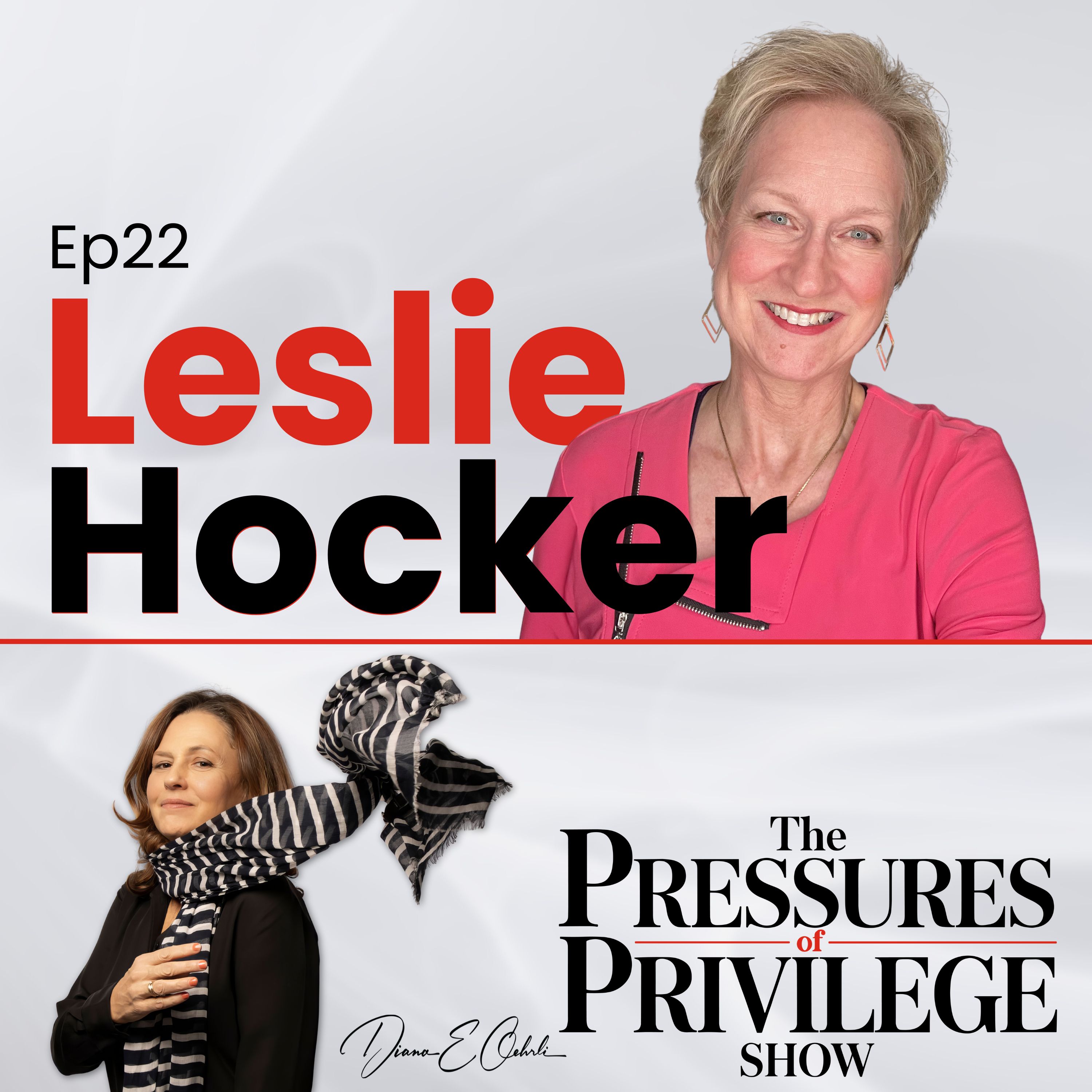
Welcome back to the Pressures of Privilege. I'm Diana Earley, and I have the pleasure of having Leslie Hawker as our guest today. Leslie Hawker was one of the first female executives in petroleum.
Then she opened Houston's first Pilates studio. Now she helps women turn back the clock on aging. But here's what I want to know.
Leslie, when you keep reinventing yourself, what are you running toward?
[00:01:09] Speaker A: I believe that we were put on this planet to make a difference. And one of the reasons that I left the.
Well, one of the reasons when I got to the executive level in the. In the petroleum industry, I worked really hard. I'm like the fifth or sixth female to get the degree that I have.
It's like a business degree, plus geology, engineering, law. I mean, it is a crazy degree. It's only at a couple of colleges. Oklahoma University and. And Texas University, two very competitive colleges.
And when I got to the executive level, I worked really hard to get there.
I mean, I got there at a very young age. My. It. It was timing, because timing and business is everything. But when I got there, I looked around and said, I am going to work in the dark, coming home in the dark, and working weekends. And I literally said, this is exciting now, as it was, but I am not doing this in my 50s. And so that.
Because I love to travel, I love family.
I love having fun.
And I was traveling from Houston to East Texas and North Louisiana and southern Arkansas and sometimes south Louisiana. And, like, that's not what I had in mind.
I had in mind traveling the world, so.
And then I really wanted to. To make a difference for people. So I. I think we were put on this earth to learn and grow and make a difference. And.
And I'm excited to be here with your audience because I. I do love sharing things that have worked for me to. To live a great life.
[00:03:00] Speaker B: Is there anything you're running from?
[00:03:02] Speaker A: I started a youthful aging movement, and I think I don't. I don't know if I'm running from it. I really more frame it as I'm doing things now that my future self will thank me for.
[00:03:18] Speaker B: Okay, because you're running away from. Is it, well, aging or.
[00:03:23] Speaker A: I. I will say so My. My mother, still a little hard to talk about. She was almost 102.
She was, you know, she just passed, but somewhere she was still living alone in her 90s. My father passed away, like, 26 years ago.
And a doctor who's a friend of mine, we were talking about my mom living alone at 98, and he made the comment. He said, well, as long as you can get up and down off the toilet by yourself, you can live alone. And I thought, oh, my God, I hate squats. This is probably, I don't know, 10 years ago. I hate squats and lunges, but I'm going to make them my friend.
So maybe I am running from aging or working to beat the clock, but I just.
I just call it youthful aging. My mother called it aging gracefully.
And she was amazing. On no meds, on no illnesses. Just her body got tired and she's like, it was time to go. So maybe that's what I'm running from. I don't know.
[00:04:37] Speaker B: 102 she was. When she passed away.
That's amazing. That's wonderful. And where did she live again?
[00:04:44] Speaker A: She. I grew up in Oklahoma. My parents retired to Lakeway, Texas, which is west of Austin, so my dad could golf.
And she lived in Lakeway for 23 years, Texas, and then moved to be with my sister north of Dallas the last several years of her life. So still walking every day. I mean, that's.
[00:05:15] Speaker B: How much did she walk?
[00:05:17] Speaker A: She walked five or six miles a day, every day.
Now, in the last several years, not as much, but she got up and. And did that.
[00:05:28] Speaker B: The.
[00:05:29] Speaker A: It was so sweet. I got. It's such a great reminder that movement is key to aging.
And so I always tell people, Diana, don't. If, if you're, you know, don't say, I'm going to go to the gym every day. If that's not a realistic thing for you. Just say, I'm going to do something for 20 minutes every day for moving. And you'll laugh because this past, I think June, a study came out, or earlier this year, a study came out about squats, and it showed that. So I try to do this. So this is a tip.
It showed that 10 squats every hour, roughly eight times a day, is equivalent to walking for 30 minutes. So I try, like, after we get up from here, I'll do 10 squats. And it just gets things moving. And every time you get off the couch or up from your desk or in the morning or. You'd be amazed how simple that becomes. So I, I've made that. That's one of the habits that I, that I've made. And I laughed when I, I. The reason I share that story about hating squats is because I think most people do.
But, but visualizing, oh, my mother as someone I respect, I love, I'm amazed by.
And the fact when my doctor said you could get up and down off the toilet, I was like, oh, yeah, that, that, that's a good reason to, to do them.
[00:07:19] Speaker B: So what is your morning routine?
[00:07:22] Speaker A: I've developed a pretty simple morning routine. Before I get out of bed, I lay there for a minute and focus on first, gratitude and then because every day is a gift.
That's why it's called the present. And I remind myself of that because I think all of us too tend to do negative self talk.
But I lie there for a minute and think about what is the one thing that I accomplished today that gets me closer to my goal? And I do planning the evening before and I look at my schedule, but I lay there for a minute just to be intentional.
And then when I get up, I immediately go get some, some water with salt and I drink. I, I try to drink 16-24oz just because it kicks off the day, but the other reason is, is that your blood thins at night. I've been amazed. I mean, thickens at night. I've been amazed how many people don't know that your blood gets thicker during the evening or during, while you're sleeping. And that's why you have so many people with strokes or heart attacks in the morning.
So I make it a habit to, to get water. And then I actually have started something new. Since you and I first chatted. I've been hanging as long as I can. I have a place I can hang.
And I know that sounds crazy, but grip strength, so grip strength is an indicator of longevity.
But also I saw a friend of mine recently who is an esthetician, who's a wellness coach, and she just, she looks so trim and she's using, she's been using all the wellness products that I use, but she just looked trim. And I said, what are you doing differently? And she said, I've been hanging every day. And I went, okay, that's, that's the universe talking to me. Because I, I was hanging sporadically so I'll hang for.
I have a place I can hang, a little room that has sun, which is the other thing I try to do is get some sunlight in my eyes on my skin.
And this particular little sun room doesn't have windows with the tinting.
So I'm. I'm trying to get a little bit of sun. All of this is happening like, it's like. Takes a minute to get the water, a minute to do the thinking, a minute for the water, a minute for hanging. And then I usually try to get at least 5 to 10 minutes of. Of sun.
And then I'm stretching because I found that motion is lotion. And if I could get some mobility, then things don't hurt later in the day. Sitting because of sitting, because I've. I've done that. And then.
And then I will take a look at my calendar again. And I usually start work probably 30 minutes in. And then I'm. After about an hour or two, I'll go get coffee.
So I started doing caffeine delayed maybe five years ago. I. I learned this from one of my brothers who's a biochemist, Kim, his doctorates in chemistry.
He doesn't drink coffee, but he knew that I did, and he shared with me. He said, leslie, first thing in the morning, your cortisol is high. Even if you only got two hours sleep, even if you feel exhausted, your cortisol is spiked. And the re. I never thought about it before. The reason when you drink coffee first thing and then you have that crash is because you didn't.
I think of it like a roller coaster or like your cortisol's up and eventually an hour or two later it's going to drop naturally.
And so I'm drinking my coffee an hour, hour and a half in to catch that wave and keep it going. And that way I don't crash.
And I've actually noticed I need less coffee as a result of that.
So that's kind of my morning routine. And then I'll. I usually eat with the coffee and I eat protein.
The last thing I'll say is as a woman, I started studying wellness when I was 16 and swimming 10 miles a day, or 16 through college, and tired all the time, and we don't get enough protein. So I try to do something with protein, eggs, vegan protein powder or something with my coffee, and that kind of kicks it off. So hopefully that was. Wasn't too long an answer for a morning routine. But most of the things I'm doing are pretty simple that people can Incorporate if you're just intentional.
And, And I would say youthful aging isn't hard, but it's. It's simple. But it, it's not always easy to be intentional. I think we, as humans, we tend to put ourselves last when we need to put ourselves first. Because if you're not around, what difference does it make?
[00:12:56] Speaker B: Good point.
So you made a switch into wellness as you were with working as an executive, being the first female executive in petroleum.
What did that cost you?
[00:13:09] Speaker A: I went far. Fast timing came out of school, college, university, before the oil embargo in the late 70s. And so now I'm dating myself.
And I guess I never really.
I. I followed passions, which is interesting. Like, I was in. I was a swimmer.
That wasn't necessarily a passion. That was as a result of my parents with five children, which I'm the oldest, what could they do to keep us out of trouble?
So if you're swimming four hours a day, two hours in the morning and going to school, and then two hours that evening and studying, you're pretty much not running the streets.
[00:13:59] Speaker B: So.
[00:14:01] Speaker A: It'S, it's.
I ended up, when I got to the executive level, a lot of success.
My boss came in one day and he said, leslie, you're really. Now, I'd already decided I needed to start a business, and I already had a Pilates studio. I started the first Pilates studio in Houston for the public. The Houston Ballet had one, and that's how I learned about it.
But my boss came in one day and he said, leslie, you're really good at what you do, but I'm sorry you make too much money.
Is like I was. I did what you did. I went.
I think I just got a compliment. And I just got fired.
So it turned out he had to fire me. I had the degree that he didn't have.
I. I had, you know, the same roughly, experience that he had, but I had the degree and they were going to put me in his job, so he got rid of me.
Took me a couple years to figure that out. But it was the worst day of my life and the best day of my life because I've traveled the world. I. I've made amazing friends, I have spent more time with family, all the things that I love to do. I met my husband that way. So he's a doctor of pharmacology. And so we, we, along with my brother who's the chemist, we hack longevity together, and we have fun with it. And it's, it's interesting. But my next door neighbor introduced Me to a company that's affiliate marketing. This was back in the 80s and I thought, well, this makes sense. I could share products I love that are working for me. I'll test them out first and if they work, I'll share them. I've never much been.
I've never ever been someone who recommended something that I hadn't already tested or was using.
So it's. I know some people can do that, but I'm too way too transparent. It's never worked for me.
[00:16:14] Speaker B: When you started the Pilates studio, were you still working in. In petroleum?
[00:16:18] Speaker A: I was still working. I say eight to faint because, you know, I went to work in the dark and came home in the dark. And as a female, I. I had to spend more hours compared to my male counterparts. But yes, I started the Pilates studio while I was still working full time. And I started in the wellness space offering wellness products because there was so little known back then. So when I got laid off, I thought, well, I'm just going to figure out how to work for myself.
Because in, in university, they, they don't teach you how to work for yourself. They.
I have a business degree. You would think they would do that, but no, they taught me how to work for someone else. I really had to figure it out.
[00:17:07] Speaker B: So what are some of the skills you learned?
[00:17:09] Speaker A: What I figured out was a lot of the skills that I learned as an athlete came in very handy, and that is competing against myself, working to be a little bit better every day because as a swimmer, you swam against the clock, but you also, because of relays, you have teamwork. So combination of working with a team of people to help you get where you want to go, and then competing to be just a little bit better every day.
And then goal setting, vision casting, goal setting. Because at the beginning of every year we said, what do you want your times to be? If you know, I don't, I don't know if your audience is all female, but obviously a lot of people know who Michael Phelps is and I always loved.
And if you don't know and you're listening, he was Olympic, like a highly, highly decorated Olympic champion.
But I don't know if you remember Diana, they talked about, he had a piece of paper by his bed that he looked at every day. So that would be.
The lessons that you learn are looking at where you want to go, looking at your vision, you know, what is it that you're doing and keeping that in front of you. So when I graduated, I had put all that aside because now I had my degree and, and then one day I went, oh, wait, all those skills I developed and I learned and I set goals and I competed against myself. And at the end of the, of the year, you evaluate where you are and then you celebrate the wins. And so all of those things are that I just carried forward into being in business for yourself. So I'm, I'm forever grateful to my parents for putting us in sports because it's not that you can't learn those outside of sports, but it helped, it helped me have success faster because I'd already been doing that as a teenager.
[00:19:28] Speaker B: I've always known about the sort of tie between entrepreneurship and, you know, high performance and sports. You know, that visualization is very important and habits are very important.
And I think you have to be healthy in both. I think, I think entrepreneurs who kind of burn the midnight oil or both, you know, both sides of the candle and don't take care of themselves, they just burn out after a while.
[00:19:51] Speaker A: And I've been there, I've been guilty of that.
Like the current company that I am affiliated with, when we first launched 14 years ago, I think I went two years non stop, no break. My husband and I, and, and, and we came out of retirement to help launch the company.
I mean, and we were having massive success, hundreds of millions of dollars. But I told my husband one day, I'm like, this isn't fun. Remember, we agreed that we would only do this if it was fun. And that's when I started with a little more balance. I mean, you're never going to have complete balance. You're going to have seasons where you spend more time with family or you spend more time on business that, I mean, you could, I could go off on a hole because I did. I've done coaching and training, next level growth. And these people that tell you you can have balance aren't actually being truthful with you because you have balance, just not all at the same time.
[00:20:56] Speaker B: So what were some of the symptoms you experienced when you felt yourself burning out?
[00:21:01] Speaker A: Brain fog.
So if you're pulled by vision in your life and your business, it should. The example that I give is when you wake up in the morning, you're on vacation, and you know exactly what you're going to do that day and you're excited.
It's called you're being pulled by your vision of what you're going to be doing when you lose. That is when you feel burnout, when you feel not excited. I know I've used that word like three Times now I don't. I'm looking for another word but.
[00:21:36] Speaker B: Or motive.
[00:21:36] Speaker A: Motivated, maybe. Yeah, motivated. When you read your vision statement, then it should be that you get excited. Like it's. You could picture it. And so.
And we weren't spending any time together.
It was crazy. And I wasn't spending time with family. And it just like you kind of one day go, what the heck am I doing?
So, you know, we're all human. I'm human. I just.
It's.
It's about being intentional all the time, and then it becomes a habit.
So what we started doing was if we. If you take a trip for a conference or business or whatever, stay an extra day or go a day early, you know, enjoy where you are.
[00:22:26] Speaker B: I'm curious. You talk about a livit list list instead of a bucket list. What's the difference for you?
[00:22:32] Speaker A: People think bucket list, as in you're. You've kicked the bucket right before you kick the bucket. My focus is on youthful aging, so I'm big proponent of how you talk to yourself. You're your own mentor, your own coach. So a live it list is these are things I want to live, I want to do, I want to be.
And so when I'm helping people with creating a vision, I always have them start with a dream list, which is what have you ever wanted to do?
To be or to have?
What. What is that? As if money is no object and time is no object. So that's a live it list.
[00:23:14] Speaker B: Okay. But I'm sure some of those are constraint. Have constraints because. Because not everybody, you know, has resources. Right, Right.
[00:23:21] Speaker A: So I'm asking people to create a live it list as if money is no object and time is no object. Just put it down. Don't judge, just put it down.
See, that's. We do that as humans. I do it too. So I. The parameters are, your money's no object, time is no object. It. You can call it a dream. It's a master dream list.
And then you look at that has no time on it.
So it could happen next year, ten years from now.
But, you know, regardless of what I'm going to share my belief, God gave us the gift of imagination. That's what separates us from animals. And so he gave us the gift of imagination to help us be pulled by vision.
No matter what your beliefs are, the Marcus Aurelius, the great works, Socrates, all of them talk about vision.
Bible talks about vision. So it's not just the Bible. It's a lot of people throughout history. So that's why the live it list where money is no object and time is no object, and it's fun to go back and look at that list and see things that you've done that you, you know, your logical mind said that's not possible. Which is what you, you just did. Your logical mind says, I don't have the money, I don't have the time at all. No, don't.
It's a, it's a dream list. It's a live it list.
[00:25:07] Speaker B: Oh, that's beautiful.
Speaking about those constraints, when you were, you know, climbing in petroleum and you know, all the shifts, the professional shifts you've had in your life, did having money or resources make things easier or harder?
[00:25:21] Speaker A: You know, it was very interesting when I, when I was in the petroleum industry and going through a rough time. I remember I actually went through a divorce. And I remember seeing to my mom and dad, well, I could always move back home. And my dad said, nope, think about that. I have no doubt they loved me, but that was not an option. My first house, my monthly payment, after I went through that, my monthly payment was the same as 12 week paycheck.
So I had to figure it out. So, yes, I've had a lot of success, but it's been, you know, one step forward, two back, three forward, one back.
And it really is deciding what is important to me and then creating a plan and then going after it. And I hadn't really thought about it from that perspective.
I think the. Really, Diana, the only difference between we think of people with money is having privilege. But the, the difference, but we all have challenges. I always used to laugh and say, okay, the difference between me and the extremely wealthy is when they have a problem, they just get on a plane and go to Mexico for the weekend and chill there.
So I've figured out strategies along the way until I could do that to help myself.
So, for instance, things aren't going well.
I'm, I'm going to, I don't know if you saw in my info that I worked. I actually helped take Anthony Robbins into the business marketplace. And so one of the things that I learned from him early on was just changing my state.
I am. If things aren't going well, a deal fell through, you know, check didn't come, money, whatever, I'll go walk around.
I, I'm blessed because I live in an area called the Woodlands, which is literally in the woods. Houses in the woods.
And I'll go outside and change my perspective and then start over. I, I just, I feel like there's always a way. And I really think it's perspective. No matter how much money you have or how much you don't, is there's, there's always a way through, a way through, a way over, a way around your obstacles. And we all have obstacles and we all have challenges. So.
[00:28:05] Speaker B: But if you were to get on a jet and go to Mexico, you might be avoiding, you know, resolving the issue. And so actually the, the problem's not getting resolved, you're just avoiding it.
[00:28:15] Speaker A: Yep, you're right. Yeah, you're a hundred percent right.
[00:28:19] Speaker B: And then you're, you're becoming resilient by learning ways of coping with the difficulties that come your way. You, you're developing some calluses, you're getting a little tougher, which is helping you deal with new problems that come along.
[00:28:31] Speaker A: You're a hundred percent right.
[00:28:33] Speaker B: Yeah. And, and it reminds me of what you said with your dad, where he's like, no, you're not moving home. I mean, he, he put you under pressure. Yeah.
[00:28:39] Speaker A: Yes. Oh, I remember thinking, oh gosh, that was my escape valve. I might have been 26, thinking, okay, I gotta figure it out. And I knew they would. Both my mom and dad would be cheering me on. But it, it was kind of a wakeup call.
[00:29:00] Speaker B: So this is kind of a nice proof or argument that coddling one's children is probably not the way forward.
[00:29:07] Speaker A: With one of our daughters, we let her do that, and then when she moved out on her own, then she came back.
And then the third time when you know, was like, okay, she's done, we actually changed locks.
She was ticked. And later she said, that was the best thing you could have ever done for me. So we're slower learners than my parents were.
[00:29:31] Speaker B: This is very inspirational. Thank you, Leslie.
I have a 26 year old daughter, so I, I think I needed to hear this.
[00:29:38] Speaker A: Today, you know, our generation, we want our children to be our friends.
And they are, but they're also adults.
[00:29:47] Speaker B: So what would you say? Actually, let's stick with this population, the people who have all the resources, you know, they want to turn back the clock, but they're, they're feeling anxious about getting older.
What would you say to somebody with wealth?
[00:30:01] Speaker A: I would say scheduling the time to do the things I shared. That's my morning routine. Look, if you don't have 10 or 15 minutes in the morning, then you don't have a life. That, that's, that is the bottom line. And yes, I usually spend 30 minutes doing all of that because I work for myself. And I have a short walk from my bedroom to my office so I don't have to worry about getting in the car and driving to work in the dark.
But I would say, you know, I'd be happy to share, you know, what I'm doing. But I would find focus on clean products and mindful eating.
And there, there's a lot of research around breath work.
There's a lot of research around moving 20 minutes a day.
It's, it's out there for all of us. So I would just say in the people that have resources.
I actually love speaking to people who feel like they don't have resources. And let's put it this way, no matter how much success you have, if you don't have your health, in my opinion, you have nothing because you don't have your health to enjoy it.
[00:31:23] Speaker B: Yeah, I was talking to a cab driver in New York City on the way back from jfk.
Nepalese guy, really sweet. And we were talking about health and junk food. And he said, well, I could go home and cook and I much prefer home cooked meals, but that's an hour I could be making money. So I just grabbed something on the way.
[00:31:44] Speaker A: So he's not put himself first.
[00:31:47] Speaker B: Well, then I said, yeah, then that money that you make in that one hour, you're going to have to spend it in the hospital in the next 10 years.
[00:31:53] Speaker A: I, I realize that we are a collection of habits. So I'm very blessed because being the oldest of five, I'll share this funny story to me is funny. I'm the oldest of five and we didn't have chips and we didn't have soda because all we ate really well and really clean. My mother was an amazing cook, but I remember sitting at the table one time saying, you know, I really like to have a soda. And my mother points over to the kitchen sink and says, the gold of the desert is right over there. And, and we all went, what are you talking about? And she goes, water.
And so I was.
Fortunately, she.
It's interesting how things are a ripple effect. So my father had weight problem. He grew up in Kansas, Southern cooking, fried food, all of those things.
And my mother set about to help him be healthier and put all of us on a calories don't count diet. That literally was the name of it.
And it was. And she said to all of us, I am not making a meal for your father and different meals for the five of you.
We're like, okay, you know, we're, we're captives, right?
It was baked Food. Broiled, you know, baked, broiled. Fresh vegetables or fresh frozen, which when I was a kid canned was a big deal. She cooked with butter.
I remember one of my friends coming over going, your mother made fresh vegetables with butter. I could never do that. I'd be so fat. And I'm thinking, okay, my mother had us on this diet and so I have really healthy eating habits. Thank you.
[00:33:44] Speaker B: Cool. I was thinking about your mom and her, you know, she lived to 102, but also, and your, both your parents actually they, and they had boundaries, which is something that we don't really see so much nowadays. So everything goes.
People make excuses for everybody. But I think your parents are a great example of. No, my, our 26 year old daughter.
[00:34:06] Speaker A: Can make it on her own.
[00:34:07] Speaker B: We believe in her and we're not going to make it easier for her. And your mom was like, no, I'm not going to make some like cook two separate dishes. I'm going to cook one thing, it's healthy and they're going to take it, you know, have it, leave it. Right.
[00:34:21] Speaker A: I, I'm gonna tell you, you're 100. Right. And hopefully I have two sisters. So I think one hopeful the one won't see this, but I'll never forget her two daughters had, were visiting my mom and one was a very finicky eater.
And my, my mother shared with us that she made the meal, put it down. And the one said, I don't like this. And my mom said, she's the grandmother, right. And usually grandparents indulge. And she said, okay, well that's the dinner.
[00:34:50] Speaker B: I love it. I didn't want to be like my mom as a parent.
And now I see that actually she was right. She didn't drive us to choir practice. We had to ride our bikes.
[00:35:01] Speaker A: Oh, I love it.
[00:35:02] Speaker B: And, and I remember thinking, gosh, what kind of mother doesn't drive their kids to choir practice? But now I just, I'm, I, I'm like, hallelujah. That was the way to be.
There's some old wisdom in the way our parents raised us, but sometimes we don't want what's good for us.
[00:35:19] Speaker A: What is that song?
You don't always get what you want, but you get what you need.
Yeah, I think of that sometimes when things don't go and, and really it's, it's the art of reframing. So when things don't go my way, you know, back to what you were talking about. I always ask myself, what is a silver lining in this cloud? What, what is it, that I can learn from this. What's the benefit of it? What's the silver lining? That has really helped me through a lot of hard, hard.
I mean, you live long enough, you have up ups and down, downs, and it, it's helped me through some, I mean, life challenges. So it's, it's been very beneficial for me. So that would be a tip that I would give to everybody is just step back and don't get in the middle of yourself, but step back and ask yourself what, what can I learn and what's the silver lining?
[00:36:23] Speaker B: I love that. But before that, you change your state, as you said.
[00:36:27] Speaker A: Yes, I do.
I get up and move and now I have a. I don't, I don't even have to. If it's cold outside or I live like some people do in a high rise, I just get up and do 10 to 20. I usually end up. I'm an overachiever. So now that I can do squats, I'll do 15 as a general rule. And that, that motion changes your state.
[00:36:53] Speaker B: Well, it's so in line with the BJ Fogg, Tiny Habits. He's got a behavior lab at Stanford University and he's the one, one who wrote Tiny Habits, which was then sort of modified and taken by James Clear with his Atomic Habits.
[00:37:07] Speaker A: Yes, I have, I do have that book and I have read Atomic Habits because, because one of my mentors was Paul J. Meyer, who's considered the grandfather of personal development.
And when he passed away, came from nothing. When he passed away, his companies were worth several billion and they're still in existence.
And that he called it an attitude of habitude.
Like I said in swimming, I was always competing to be 10. I've won races by a 10th of a second, so that's a tiny fraction of being a little bit better.
[00:37:50] Speaker B: Professor Fogg says that, you know, the tiny hat, if you keep them small, then it's that you, you increase the ability to do them and you're more likely to do them every day and they become automatic. So the minute you get off your up from your chair, now you have this, your body just does them, probably without thinking.
[00:38:08] Speaker A: Yes.
[00:38:09] Speaker B: Yeah. And that's that automaticity that we all want with habits.
[00:38:12] Speaker A: Yes. I hadn't thought about it from that perspective, but I'm always thinking about it from the perspective of my future self. When I don't want to do it, I say to myself, my future self will love me for this and we all want to be loved.
[00:38:29] Speaker B: That's amazing that you're able to do that because you know, you know that, that experiment with the children who are saying, well, you can have the, you know, one, one marshmallow now, but if you wait two hours, you get two.
And the kid who can wait the two hours for the two are usually the ones that are able to do better in life than the one who want, who gets the instant gratification of the one.
[00:38:50] Speaker A: And that is a challenge that we are in an instant gratification society because I coach and work with people to be in business for themselves, teaching them how to be entrepreneurs. That's, that is the biggest challenge is getting people to commit to a period of time where they're doing the activity and it looks like nothing's happening when the iceberg, you know, the iceberg is bigger below than it is on top of the surface. And we're, we're so taught as a society to trade our time for money, etc that we, we, we don't have that delayed gratification perspective.
That ability to do that is probably what helps people be entrepreneurs and in business for themselves.
We overestimate what we can get done in a day or a month versus what can actually happen in a year.
[00:39:56] Speaker B: What about working in a team? You work with your husband in this business.
[00:39:59] Speaker A: We haven't killed each other yet.
[00:40:03] Speaker B: Does it, does that help to, to be two?
[00:40:06] Speaker A: Yes, it helps because if you're both. Well, in this case we're both we.
If you're a husband, wife, team or you have a partner, then you work on your goals and where you want to go separately and then you come together and look at like he loves the fish. I could care less.
I like to eat the fish.
I laugh when I say that because his, one of his goals is property that has a lake right out the back deck so that he could go drop a line off the back deck.
But for me, I'm happy to go along with that because it. The beautiful scenery. But we both. I would not have put that piece in my vision statement. But when we come together we're, it's interwoven in that respect.
And it also helps when you have a team of people. I want to focus on my strengths and then find people to work with and recognize what I'm not good at so I can spend more time doing what I'm good at. I'd rather make less money and have a group of people I'm working with that we're all moving excitedly in the same direction so that we all succeed. I don't know how else to explain it, but it's a lot less stress. And I'm all about less stress. Less.
[00:41:40] Speaker B: Well, it's, it's one of the longevity markers. Right. Not having stress and also community.
[00:41:47] Speaker A: It's very interesting. You've seen all the blue zone stuff.
Have you noticed that it, the diets are not the same?
[00:41:55] Speaker B: The.
[00:41:56] Speaker A: It's like the only thing that's the same is community.
[00:42:01] Speaker B: And movement. Yes, Movement.
[00:42:02] Speaker A: Yes.
[00:42:03] Speaker B: Yeah. I just met Dan Vietnam last week in Florida.
We were talking about how some of these blue zones are not blue zones anymore and how tourism, because of the blue zones designation, they've. Tourists have flocked to those areas and brought their bad habits with them and are destroying the places that were once blue zones.
[00:42:24] Speaker A: Oh, that's sad.
[00:42:26] Speaker B: That is sad, isn't it?
[00:42:28] Speaker A: Because if you, if you look, it isn't the place so much as the overall habits.
[00:42:37] Speaker B: Culture.
[00:42:38] Speaker A: Yeah, and culture. Exactly. Culture and community.
[00:42:42] Speaker B: And a lot of these places too, weren't polluted by greed or by, I would call it the materialism of our capitalistic society, where it's like everybody now wants a television set, two car garage, they want the glamor, they want the luxuries. Whereas before they maybe had a simple lifestyle.
[00:43:04] Speaker A: You know, it's interesting you say that about the television. So when my husband Ron and I got together, I, I remember telling him, we are not, this is from past experience. We are not having a television in the bedroom. He's like, like, no, we are not.
[00:43:20] Speaker B: See, boundaries. I love it, Leslie.
[00:43:22] Speaker A: Yes. Yeah. And it's been 30 plus years now and it just like it.
Neither one of us missed that.
[00:43:32] Speaker B: So maybe that's a secret to a good marriage.
[00:43:34] Speaker A: Yeah, there you go. One of them.
[00:43:40] Speaker B: And being able to work together, I mean, that's just.
[00:43:42] Speaker A: We put in place early on that when we had a disagreement, it was really important to separate that it's the. Your. It's not that you don't love the person. So it's like, I love you and this thing that's happening isn't working for me. And it's just like all the, It's. When I coach people, Diana, I do the same thing. I find something you're doing right and I say, hey, this is great.
Do I have, I don't ask my husband if I have permission, but I will do the finding something right. And then with the people I'm coaching, it's like, do I have your permission to give you some tips that will help make this better?
And people are more open when you're asking permission rather than you. And always, you know, we remind each other because it's not that we don't get in disagreements, but it's when you're pointing one finger, you got three going back at you. And it's, it is interesting. My brother in law one time said to me, I don't know how the two of you work together, I can never do that with your sister. I'm like, well, personal growth mindset, making a decision that you're going to make it work.
[00:45:08] Speaker B: So if somebody did want to work with you, what is your ideal client and how do you work?
[00:45:12] Speaker A: Well, right now the project that I'm working with is I just helped launch a natural alternative to Botox and fillers, to injectables, to natural alternative to neurotoxins.
And if they go to lesliehawker.com you know, people can choose to inquire about the products, they can choose to inquire about working with me. But my ideal client is somebody that wants more choices in life, likes to make a difference, has a little bit of entrepreneur attitude, is open to looking and if you're someone who's been wanting to be in business for yourself or start a business, I would be happy. There's multiple different things they can do. And I'm also looking for people that I can coach, that I can work with and I am in the, the direct sales space which is a, most people don't realize that's a $200 billion global marketplace. So people can do it spare time, they can do it full time. I love being able to make a difference for people so that if they want to make an extra 500 to a thousand a month, they can or if they want to make couple of thousand or more a month or as a friend of mine said, or they want to make gangster money, they can legally.
[00:46:45] Speaker B: So they, they would be selling your.
[00:46:47] Speaker A: Products, they, they would be.
[00:46:51] Speaker B: Cool. So, so they can reach you on.
[00:46:53] Speaker A: Lesliehocker.Com they can reach me on lesliehocker.com just fill, there's like name info and we'll set up a time to talk.
They can also reach out to me. I'm on Facebook as Leslie Hawker.
[00:47:07] Speaker B: And yeah, I'll put the links in the show notes.
[00:47:09] Speaker A: Okay. And I'm on Instagram a little bit and LinkedIn. Someone asked me on another podcast how did I pivot? And you sort of kind of asked that and that was what I had started to share with you, that I have followed passions for things that I'm interested in. And then when I figured out oh, other people. I can make a difference.
It's interesting in this space of direct sales, because just because a company has a good product doesn't make it a good business. They don't teach you all this stuff in business school. So I'm all about helping people sort through the gotchas and find something that works for them, whether it's with me or not.
I love the space, and I love that I've been able to impact thousands of people around the globe.
[00:48:05] Speaker B: Yeah, well, you walk the talk, Leslie. So it makes it probably a lot easier to sell the product and to get your coaching clients.
I was, I was curious, what would you say to somebody who doesn't like sales, but sales is integral to their business?
[00:48:18] Speaker A: You'll laugh, because my brother, the biochemist, that is shy scientist.
And if. If you have a system that it works. But I was. He had quite a bit of success, and I introduced him and I made the comment that he couldn't sell his way out of a paper bag.
And he got ticked at me and I. Because he. He can't sell. But he goes, he says, don't you realize we all sell every day? We sell our children, we sell our parents. We sell, you know, people we're dating. We sell our spouses. I went, okay, you're right. I'm so sorry. And it's because I had taught him. He's very shy, and I had taught him the difference between sharing and letting other people decide and selling, which is high pressure.
[00:49:13] Speaker B: So there's a difference between the high pressure.
[00:49:17] Speaker A: Yeah, because people convinced against their will or of the same opinion still.
And so what I do in, in direct sales is people can send their product. They have 60 days. They could send their product back if they don't like it. So it's high pressure, doesn't work. So I. I teach people how to be a solutionist, how to provide solutions for people, how to listen to people to help provide solutions for their life. So when others win, I win. And that's Diana. Truthfully, what I hated about corporate America, for me to win, others had to lose.
And in the space I'm in, I win when others win, we win together. So it's a win win. And that. That's how I. I want to do business.
[00:50:10] Speaker B: I think that's a lovely end to our conversation.
Thank you so much, Leslie.
[00:50:15] Speaker A: You're welcome, Diana. I enjoyed it. I appreciate the opportunity to share and hopefully have made a difference in at least one person's life.
[00:50:24] Speaker B: Yes. Well, you're very inspirational, and you gave us some really good tidbits that we can all already use.
If this episode landed for you, share it with someone who might need to hear it. And if you haven't already, subscribe so you don't miss what's coming. But here's the real thing I want you to know if you're carrying something you can't talk about, if you have every resource except someone who actually understands what wealth costs. I work one on one with people like you navigating exactly that. You can reach me@diana oehrli.com thanks for listening.