[00:00:00] Speaker A: I don't know how many people say to me, I just want to live my life. That's a head scratcher. It's like, well, yeah, but you're not going to live your life if you're going to keep doing what you're doing. You want to live your life, aim to be healthy.
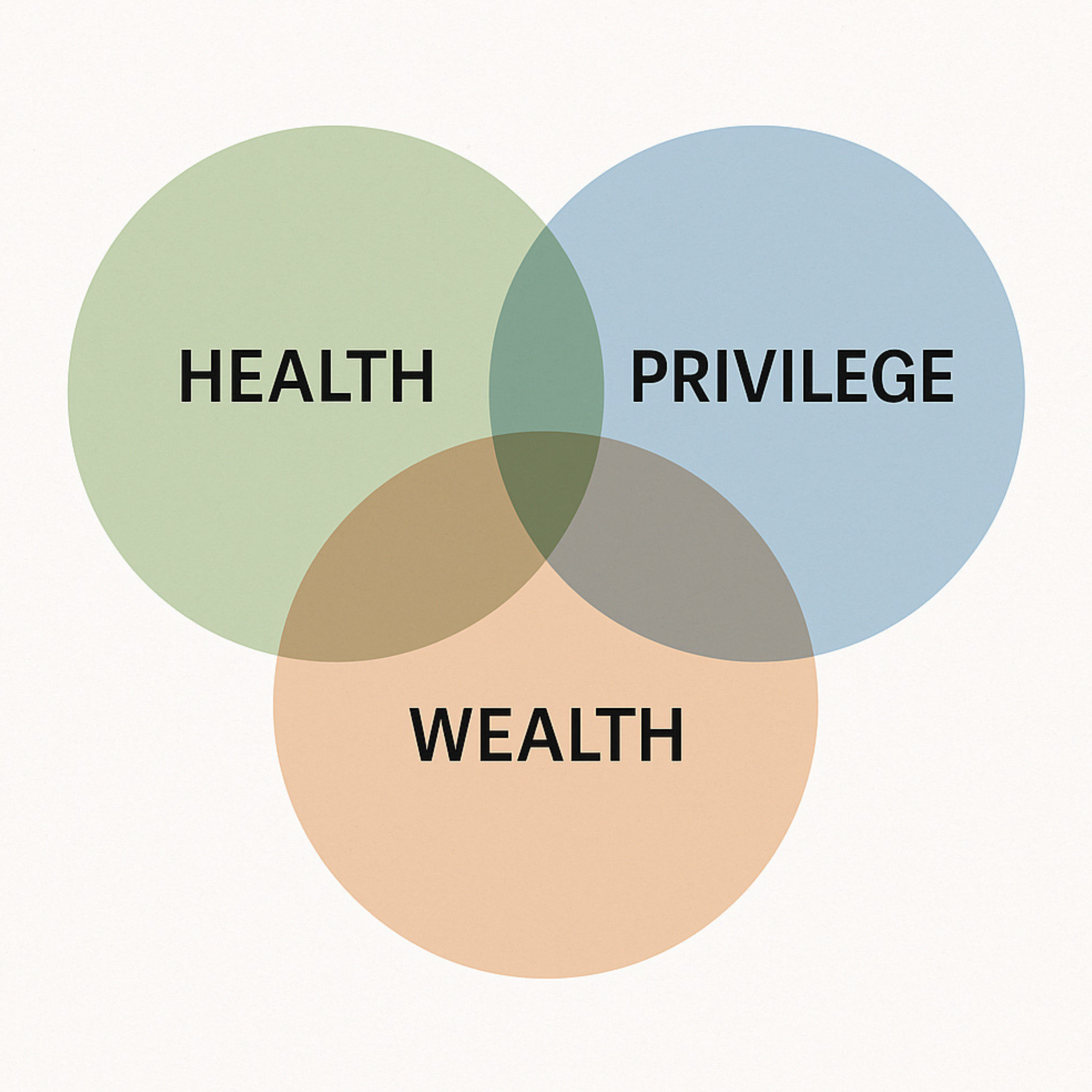
[00:00:13] Speaker B: I'm Diana Earley, and I've spent most of my life learning firsthand what privilege actually costs.
The legacy control, the family expectations, the guilt of feeling trapped in a life everyone thinks you should be grateful for. If you've ever wondered why having everything still feels like something's missing, you're in the right place.
Welcome to Pressures of Privilege.
Today's guest is Graham Holley, a certified health and wellness coach and the founder of Simply Health Conscious. Graham helps people lose weight and get healthy again without crash diets or gimmicks. But here's what makes him different. Graham is British and what he teaches his American clients. Cooking real food, moving your body, skipping the junk, isn't some special system he invented, it's just how he grew up. It's normal life where he's from. Here's the thing, though. Americans and Brits used to have that too.
Somewhere along the way, ultra processed food and big food took it from us. Graham's spent his career trying to help people get it back.
Please welcome to the show Graham Holley.
[00:01:25] Speaker A: Well, thank you, Diana. I appreciate the invite.
[00:01:28] Speaker B: I love your story. You came to the United States 40 years ago. Why'd you come over to this country?
[00:01:36] Speaker A: Came on a visit and I met a girl when I was living in London. She invited me to stay with her and her family and kind of rest turned into history.
[00:01:46] Speaker B: Thank God I'm not the only person who's moved because of a love interest.
[00:01:51] Speaker A: Oh, I think it's quite prevalent.
[00:01:55] Speaker B: So you grew up in Britain. What did the normal relationship with food look like there versus what you see in American clients now?
[00:02:03] Speaker A: Yeah, well, when I was growing up in England as a teenager in my early 20s.
Well, you didn't really. When it came to food, you didn't really have an option but to eat real food because there weren't fast foods around. There weren't fast food chains all over the place.
Supermarkets weren't 90% of, you know, this man made products.
It was just real food.
And if I look back as well, there weren't such a really three meals a day and snacking in between. Nah, that just didn't go on.
You had breakfast, lunch and dinner. That was it.
And I think a Part of that is when you eat real food, your body naturally produces GLP1.
And that's a part of the big problem today is that these man made foods, whether it be fast food, anything in a box, tub, pocket, can wrapper, they've got all these unhealthy, simple carbohydrates. And let's not, you know, let's not brush away all the chemicals in there and the preservatives, even hazardous chemicals. Well what they're doing is they're stopping the production of GLP1. That is why people, two hours after they've ate something, they're looking for a snack and then they turn to a snack which is unhealthy. Fats, salt, sugar, it's just a vicious cycle.
It's, it's man made and I'm going to go out on the limit and say it's planned, it's planned.
Look, the three meal a day snacking is planned, there's no question out of that. And it's to just to get you to eat more of this addictive, unhealthy food. And this is why we've got lifestyle disease. Well, it's not even an epidemic, it's really a pandemic.
Children as young as 5 years of age and teenagers are getting diagnosed with non alcohol fatty liver. If you go back 40 years, there weren't a such thing as non alcohol fatty liver. The only fatty liver people were developing over the centuries was alcohol fatty liver.
And then all of a sudden kids were getting fatty liver and they're like, where's this coming from? Oh, it's all this unhealthy carbohydrates and ingredients. But hey, let's not say anything. Let's not say anything.
Yeah, it's, it's turned my life into a passion to get my message across and to help people that they don't need to be struggling with lifestyle disease.
Again, I hate to say it's planned, but if you look at big food, big pharma and even where we are at the medical industry and it's the same in England, you go to your doctor whether you're taking your child as a teenager or a 10 year old.
Well they're not, they don't rejuvenate your health, they manage your disease with pills.
And what got me really into, I got into this by default. I've only been a health and wellness coach for six years.
What got me into it is every time I'd go home and visit my brother and my father, I saw the health declining every Year goes by, and until I, until it, until it woke me up, I'm like, wow. Heart attacks, bleeding, ulcers, loss of eyesight, kidney disease, liver disease, anemia, pancreatitis, 12 medications.
Am I setting myself up for this? As I started to delve into the research, it was quite mind blowing. I'm like, what?
It's like everybody's been conned and they're just not aware of it because of the misinformation, the disinformation and deceptive packaging by food companies. Fat free, sugar free, organic. Honestly, you got to ignore that.
With myself and my clients, I slowly have moved away from, well, I. Fast food. I've not been in a fast food restaurant in six years and I'd rather I'd skip a meal before eat. Fast food. People have no idea how it's made. They have no idea how it's made.
And yeah, just to slowly start to make all your meals out of real whole food. And when you find you do that, the snacking disappears.
And then if you can, if you want to be, if you want to go a step further and introduce fasting, then you can eat two meals a day and you can get all your quality protein, your fiber, the three essential macronutrients, healthy fats.
You can't get your three essential macronutrients from fast food and processed food. They don't, they just. It's void of fiber, which is fiber is very helpful for your gut.
And there's another thing people overlook. Your gut is tied to, immune to your immune system, tied to a lot of, you know, thyroid issues.
So you have to protect your gut. You have to protect your liver and feed your gut if you want to be healthy. Unfortunately, you got to be educated to be healthy, which is bizarre.
It's not even taught in schools. Right. The two most important things in anybody's life is health and finances.
Not taught in schools, colleges, universities. There's no TV programs out there. What they should be doing is teaching kids in school how to be entrepreneurial, how to go out there and really thrive in life and create things, help people. But they don't do that.
[00:08:19] Speaker B: So great. You know, the Americans haven't brainwashed you yet. You're so sensible.
[00:08:26] Speaker A: Well, again, I didn't used to be. And that is the thing. I was like everybody else. I used to, when it came to food, go, what looks good, tastes good and smells good, I want it.
But once you start to understand that you can't do that anymore, not if you want to be healthy.
And then I think Overall, optimal health goes beyond just what you're putting in your stomach, is what you're rubbing on your skin.
All these unhealthy carcinogenic properties. Sun creams and moisturizers, lip gloss, deodorant, toothpaste, it goes on and on and on.
I mean, I'm not surprised that young kids, teenagers, young kids, it doesn't matter what age you are now. You come out your mother's womb, you're very susceptible to getting disease.
[00:09:20] Speaker B: So how can you tell which product is good for you and which product is not good for you?
[00:09:25] Speaker A: First of all, if you are eating anything out of a box, tub, packet, counting a wrapper, you have to look at the. You have to look at the ingredients label. Because what I have found over this last few years is there are some respectable companies out there who are producing healthier, let's call them snacks, if you want, or things in boxes, tubs. But here's the big but.
You really have to spend time looking.
Let's say, for instance, I was looking for some barbecue sauce the other week.
Took me about 10 minutes to find a barbecue sauce because everyone had sugar.
Most of them had chemicals in. And how do I know that? Well, one, I looked at the ingredients labels, but I say if it's got more than three or four ingredients, well, then you need to be a little suspect. But I have an app on my phone called Yukka. I'm sure you've heard of that, Diana, have you?
[00:10:29] Speaker B: No, I use it.
[00:10:30] Speaker A: Yeah, it's a great app. I use it. If I'm ever buying anything out of a box, tub, packet, carton wrapper, which is very minimal these days. In fact, I clean my pantry out.
I often clean it out, and I really give it a good clean out. And when I stood back and looked in my pantry, there were three things, three things in there.
It's same as my fridge. I don't use sauces out of bottles. It's full of some type of sugar or sweetener or chemical.
So make your own dressings, make your own food. So again, I think it's just slowly, and I say slowly, small steps. If you just take these small steps on a weekly monthly basis, you'll be shock how you can turn your health around, how you can lose weight.
I say every client I've had so far who usually come to me for weight loss, but some of them come with high blood pressure and type 2 diabetes. And, you know, I'm not a doctor, so I'm not there to help them get rid of the type 2 diabetes. But here's what happens.
First of all, when I get a client, I always make sure they go to the doctor, they tell them they're making lifestyle changes.
And I recommend this to anybody who's making lifestyle changes. Have your blood work done and learn how to read it yourself. It's not that difficult because you go and get a lot of information out reading your own blood work, your doctor might not even mention.
I hate to talk like this about the system, but it's a broken system, I don't think.
I think most people listening to this are going to hold that against me because it is a broken system.
Learn to read your own bridges. So what my clients have experienced, usually after, you know, eight, 10, maybe 12 weeks, they're going back to the doctors.
Also, I do have to say this. If you're going to, after this episode, if you decide you're going to make lifestyle changes, you need to get a diary. You need to get a sheet of paper, a notepad and a pen. And you need to, if you're on high blood pressure medication, type 2 diabetes medication, you need to log it down. Not just take it three times a day, but log it down. Because eventually, and I guarantee you eventually, you'll be going back to your doctor because you'll say, and then you'll have a good point of reference. Hey doctor, I came to see you 10 weeks ago, I told you I'm making these changes. Here's where my blood pressure was then, here's where it was on week 2, 3, 4, 5, and here's where it is now. Because my clients have experienced, the doctor says, wow, fantastic.
But going to have to reduce your medication and then they keep on these lifestyle changes, within maybe a couple of weeks they're going back and they eliminate the medication.
[00:13:37] Speaker B: That's fantastic. Have you had any clients who actually will fast if they don't have the right food around?
[00:13:43] Speaker A: Well, that's a good question. I can't really answer that.
[00:13:46] Speaker B: Well, I struggle with that. I find it really hard to fast.
[00:13:50] Speaker A: Oh, you see, I don't. And I do try and, well, I don't try, but I talk about fasting to my clients and some take it on and some don't. But if I go back to my lifestyle when I was eating three meals a day, snacking, eating, drinking alcohol, an hour before, I pretty much had all the unhealthy habits out there.
I'm down to now two meals a day within a six to seven hour window of eating.
I like to have my last meal around, maybe 6 o' clock in the evening, 6:30. I don't like to go past 7. I go to bed at 11 and 10. This is part of your sleep routine, is not to be eating and drinking alcohol and eating food at least three hours before bed to say, I say more if you can, but I think something fasting is something you have to slowly work into. You're not going to wake up one morning from eating three meals a day and snacking or eating two meals a day. That's not going to happen. And nor do I recommend that I get up around.
I don't set an alarm clock very. The only, the only day I set my alarm clock is on a Thursday because I go to a 7 o' clock meeting at Toastmasters.
But the rest of the time I usually wake up to go, I don't know, 6:30, 7. And I just, you know, ease my way out of bed and then I've got my morning routine.
My morning routine is to hydrate straight away. Most people go straight down for coffee, right? They want the caffeine, the scrolling on the phone, the answering emails, they're getting stressed. Because what happens is when you wake up on the morning, your body naturally releases the cortisol, the stress hormone.
And it is, and it's actually in the morning, especially if you're over 60, is, is when your blood is the thickest in, in your old body, is when you wake up on the morning. That's why there's a lot of after 60, 70 people have strokes or heart attacks in the morning because they're not, they probably aren't adhered to these routines. So I get up, look, you've been in bed for X amount of hours. You probably didn't drink water two hours before you go to bed, you need to hydrate.
That's the first thing you should do is hydrate.
I put a squeeze of lemon in mine and some Mediterranean Sea salt for electrolytes and I hydrate for the first 30, 40 minutes, keep away from coffee. And then the next thing I do is just nothing extreme but just move your body, get that blood moving around and when I say no extremes, just do some squats. 10 squats. If you're just starting to do this, hold onto your sink or your countertop, just do some squats. Even if you're just doing this circling your arms, just get that blood moving around, you're hydrating because what that does as well because when you wake up you've got this cortisol rush, your nervous system's all on edge it's up to us to send messages to say everything's okay, I'm just waking up. You know, there's no tigers outside the cave. It goes back to beginning of mankind and then the next thing to say is good. And this took me a little while to get into that route. I could easily get into the hydration and move my body and then I'm like, all right, time for coffee now. I better get me scrolling on my phone, my messages, check my social media. No, avoid that.
[00:17:49] Speaker B: How do you do that?
[00:17:51] Speaker A: Well, we need to look at as morning like a, like a warm up and not out, straight out the starting blocks. And most people are straight out the starting blocks.
[00:18:02] Speaker B: Warm up.
[00:18:03] Speaker A: Okay, warm up and even they say this is better. And this is part of locking your circadian rhythm with your evening routine and your morning routine sets. The circadian rhythm is just to step outside and look into the vast.
The vast. The sky out there, it doesn't even need to be sunny, you just need to.
When your eyes have got all that vast in front of you, apparently it brings your nervous system down.
So you've got your hydration, you're moving your body. Even better, just walk around the block. I can't help it now I started walking around the block now and now I go on a 30 minute, 40 minute walk.
[00:18:41] Speaker B: Do you have a dog?
[00:18:43] Speaker A: No, I don't even have a dog without a dog.
[00:18:45] Speaker B: You do that every day.
[00:18:46] Speaker A: Yeah, yeah. And here's the thing, here's the thing. When you do and again, don't think you're going to wake up one morning, hydrate, move your body and go for a 30 minute walk. And I'm not telling everybody they should go for a 30 minute walk. And sometimes it's only 10 minutes for me. But it's like I say, you've got to warm up into the day and not straight out the starting blocks. Now I know what a lot of people saying, I don't have time, I've got my kids to deal with, I've got to get to work. Well, maybe go to bed a little early and get up before your kids get up.
Relax. You can do some stretching even if you want to do some meditation. But that warming when, if you do what all I said, even if you step outside for a few minutes, you come back inside, you won't be thinking of caffeine because your body will be awake, your mind will be awake, you'll be like, all right, what's next? All right, well, I better get to my emails and I think this Coffee thing for me was more of a habit.
I like coffee, I love coffee. And I drink coffee using my first cup of the day. I have decaffeinated coffee at home, where I am at home now and also caffeinated. So my first drink of my first coffee is really the habit of I just love coffee. I make a latte, a double espresso, even though it's decaf, just coffee. I put it in an espresso and I make myself a nice latte. But I'm not doing it for the caffeine. I'm already awake.
[00:20:22] Speaker B: That's a good tip.
[00:20:23] Speaker A: Very important, these evening routines, morning routines, and again, my program is about the five pillars of health. Nutrition, exercise and movement, sleep quality, stress management, and being mindful of alcohol consumption. Because if I've learned anything over the years is that these five pillars do not work independently.
If one of them or two of them are ignored or pushed aside or, well, eventually you will be. The other pillars will pay the consequences. And here's something here, Diana, I think a lot of people are not aware of.
Let's just go back to the fact that children and teenagers are now getting these lifestyle conditions.
It can take years, even decades, before symptoms show up.
So by the time symptoms show up, you've already done and doing damage to vital organs that you're just not aware of.
[00:21:34] Speaker B: Can you repair it?
[00:21:36] Speaker A: Yes, you can. You'll be surprised. Now, obviously there's a point of no return. Like, can say my brother and my father got to a point of no return. But, yes, it is.
I had a client come to me. She was a Dyer for 10 years.
She's not a type 2 diabetic anymore. She doesn't have high blood pressure anymore. She's lost weight. I tell you, this is. Let me tell you the best story, my best client recommendation, whatever you want to call it. Testimonial. I had a client came to me for weight loss. He had high blood pressure.
We worked on the five pillars. He wasn't a big alcohol drinker, so that was the easy one for him. But he worked on the other five pillars, and after about eight weeks, we parted ways. You know, I'm not one of these who keeps me clients on. You know, it's like, have you got it, mate? It looks like you've got it. You know, you're starting to lose weight now. You've got your nutrition down, you're moving, you're getting your 10,000 steps a day, and you've reduced your stress.
You. You've got your morning routine. Your morning routine. Let's.
I think you're good now. Anyway, I asked him for a testimonial.
He gave me a testimony and his testimony was something like, yeah, I worked with Graham for eight weeks.
My doctors reduced my blood pressure medication. I'm hoping he can further go to eliminate it, which he did eventually have it eliminated. I've lost weight, I don't need afternoon naps, I've stopped snacking, et cetera, he said. But the funny part of this story, and this was all unbeknownst to me, because I do all my sessions through zoom or even just sometimes on a telephone. At that time, I was doing it just on the telephone, but he had me on speakerphone and his wife was in the room. Never said anything. She was just observing, he said. The funny part of this story is, he said, my wife has also followed Graham's recommendations and within this eight week period, not only has she lost weight, but her doctor has reduced and eliminated her high blood pressure and type 2 diabetes medication.
Now, that was overwhelming for me.
It really was. Even now, I get emotional.
[00:24:10] Speaker B: Yeah, I can see that.
[00:24:13] Speaker A: It's, you know, we don't need to be living with these. I saw what type 2 diabetes can do if it's managed.
I saw it with my brother and my father. Managing type 2 diabetes is not the answer.
Not the answer. Especially when it's.
And here's another thing I've learned, which is pretty much common sense.
When you stop feeding, the disease, the disease goes away.
Now, when I say feeding, I'm not just on about food. I'm on about, you know, exercise and movement, sleep quality, stress management, alcohol, mindful alcohol.
People's blood work gets back in order.
That's why I do recommend everybody learn to read your own blood work and have it done twice a year. Not one. Look, this going to your doctors, having your blood pressure taken once a year. Excuse me. It's a joke.
[00:25:09] Speaker B: I have a friend who's a vet and her husband just went and got his blood work done. She, for some reason, their emails emerged. So she read his results before he did, and she saw that his A1C was really elevated. And she was like, oh, no, he's pre diabetic. She knew that. She's also very scientific.
And she went to her husband and said, honey, we've got to make some changes. And he went to his doctor and the doctor was like, yeah, your blood works fine.
[00:25:37] Speaker A: Yeah, I know, I. I know. I don't really want to go down that rabbit hole, but I have because I Know what I know, and I know what I know about the system. I advocate for myself at the doctors.
And if I didn't, well, yeah, no, it's.
Unfortunately, in today's world, you know, what are we, 20, 26? If you don'. Educate yourself, you will slowly drift and your children into metabolic dysfunction. Because it's easier now than ever to drift into metabolic dysfunction. And then. Yeah, when you go to your doctors, all they do is manage it, explain metabolic dysfunction.
[00:26:20] Speaker B: I mean, I know what it is, but I'd love to hear your.
[00:26:23] Speaker A: It's an accumulation of certain things, whether it be high blood pressure, visceral belly fat,
[00:26:33] Speaker B: diabetes.
[00:26:35] Speaker A: I'm sorry, yeah, diabetes.
I mean, even gut issues. Gut issues are very common. Skin issues are very common. There's another thing. I've had clients come to me again, not because I'm not a doctor, if someone comes to me and says, oh, can you do anything about my skin issues, my psoriasis or something? I go, not really. But what I found out is that when you stop feeding, when you stop poisoning yourself, all these things just drift away.
[00:27:04] Speaker B: Yeah. I had a doctor in Switzerland who, you know, I got diagnosed with a celiac. Well, recently celiac, but prior to that it was a gluten allergy back in Switzerland. And I went back to my doctor and I showed him some old lab results and I said, look, my ig, which is like the marker that shows you have an allergy, was really elevated and why didn't we go down that rabbit hole to find out what I was allergic to? We said my clients never adhere to a diet, so I don't even bother.
[00:27:37] Speaker A: Yeah, it's sad. It really is. I mean, why? Look, the two most important things in anyone's life, you know, I think we mentioned it, is health and finances. Not taught in schools, not taught in colleges or universities. There's no TV programs out there.
Yeah, you gotta get engaged with your life and your health, otherwise you're setting yourself up. Look, here's the. I throw this question out to lots of people. What's the point of working so hard, building a family, building a business, building wealth and equity?
Well, if you can't even get out of a chair, life's there to enjoy. And there's no reason you shouldn't be.
You know, I still play football, soccer, three times a week with an over 60s crew.
And there's a couple of them guys at 80 years of age, and they show up three times a week and they're running around for an hour and a half.
You know, why?
Because they don't eat fast food and processed food and they exercise, they move, they get quality sleep. They've just done that.
It's just what they've done most of their life. But unfortunately, most people are not tapped into how to be healthy. And in people's defense, even people who are overweight, it's not their fault to some degree. Now, if you know why you're overweight and you're not doing anything about it, well, then it is your fault. And there's plenty of people out there, plenty of people out there who really, I don't know how many people say to me, I just want to live my life.
Well, that's a head scratcher. It's like, well, yeah, but you're not going to live your life if you're going to keep doing what you're doing. You want to live your life, aim to be healthy.
[00:29:31] Speaker B: Well, it's been proven that these foods are addictive. Have you read Ultra Processed People?
[00:29:36] Speaker A: Yeah. No. Yeah, yeah, I've not read that one, but there's lots of. Well, look, it's a fact, isn't it?
Even fast food, fast food and processed food is cleverly engineered by food scientists to be addictive. When they're coming up with these products, they test it out on hundred people, they put scans on them to see if they're releasing dopamine. And once dopamine's lit up, they go, that's it, get it on the shelf.
Because sugar is very addictive. They say it is addictive as heroin. Well, I don't know. I've never done heroin, but sugar is addictive. I was addicted to sugar. I didn't realize until I started to make this journey myself how addictive, how addicted I was to sugar.
You know, I'd sit down and watch TV with a pint of Haagen Dazs in front of me, not think twice about it.
[00:30:29] Speaker B: Yeah, it's hard to go through the withdrawal. I, I once got off sugar.
[00:30:32] Speaker A: I'm.
[00:30:32] Speaker B: I'm back on the sugar train and I need to get off again. But it took me about a month of eating fruit actually to get off the.
It's hard to go cold turkey.
[00:30:45] Speaker A: Listen, I agree with you. I same with alcohol. For me, I had a, you know, I want an alcoholic. But I showed up for work every day. I didn't drink while I was working, but after work, time for a drink. And I weaned myself off of alcohol. I went from I weaned myself off a bottle of wine a night to a Bottle of wine a month now.
Only time I'll have a drink is if I go out for a nice meal. I'll have a glass of wine. A glass of wine, not three glasses of wine. And then go home and open another bottle of wine.
[00:31:22] Speaker B: That's good, you can control it. Because I don't know if I could do that.
[00:31:27] Speaker A: We've got all these things, all these temptations in front of us what make us feel good.
But you just gotta be a little. You just gotta be a little kid. Look, here's the thing. Don't mean to say you can't have a drink. And I just mentioned ice cream. I still eat ice cream. I'm not sat down eating a tub a night. I don't have ice cream in my house. What I usually do is after a meal sometimes at home I always go for a walk after my meal because it's a blood sugar hack. It helps reduce your blood sugar spike.
And I walk to an ice cream shop near me and I'll get a kid size portion. Even the kid size portion is like this is not a kid size portion.
Adult size portion, you get lost in. It's as big as my head is the adult size again. So everybody thinks to be healthy you gotta be eating tomatoes and lettuce.
No, I'll be honest, I'm actually eating the best food I've ever ate in my life. I actually enjoy cooking now. Here's another hack as well.
Because I'm like most people, I don't want to, you know, come home at 5, 6 o' clock and then spend an hour in the kitchen in my fridge 24 7. This is a great. You want to eat healthier?
Do this in my fridge 24 7. Whenever you open my fridge, you're going to see a big dish of mixed roasted vegetables which usually consists of mushrooms, red peppers, green peppers, onions, fresh garlic and broccoli sprouts. That is always in there in my freezer I always have, you know, lean organic meats and chicken, wild carts, fish and salmon. I always, I call that my protein.
So what I do is on the morning when I get up, I'll take two pieces, whether it be a steak and some salmon out. Then when it's ready for my meal, I'll go put my salmon on the barbecue.
And also in my fridge I always have the ingredients of a Greek salad.
So if I want to say I've had salad and the Greek salad, go put that on the barbecue, come back in, chop some kale up, it's already washed, chop Me kale up.
Couple three or four spoonfuls of the Greek salad have already got made up.
Go back, flip me salmon, come back in literally within seven or eight minutes, I've got Greek salad.
[00:34:11] Speaker B: But the roasted vegetables you already had to do.
[00:34:15] Speaker A: Yeah, I roast them. Yeah, Usually on a. Well, just whenever I'm running low, I always just roast them. It takes me what, maybe 20 minutes to chop everything up, put them in the oven for 30 minutes and I'm done. And I've got, and, and I can pair those with, I pair those with, I mix those with scramble. Three, three egg scramble.
I always have an avocado every day, if not two, so I can bang a real healthy meal together within literally minutes.
[00:34:46] Speaker B: So wait, do you put oil on your vegetables when you put them in the oven?
[00:34:49] Speaker A: No, I don't. No, I don't do anything. I just roast them. Now when I warm them up. Yeah, I put a knob of butter in my frying pan and then just saute them. So look, while we're talking about fats, let's talk about fats because again, this is all proven. This isn't me making things up, but this canola, safflower, sunflower, corn oil.
[00:35:21] Speaker B: Yeah, the seed oils.
[00:35:22] Speaker A: Yeah, the seed oils. Get them out your house.
They're inflammatory.
[00:35:27] Speaker B: What about avocado oil? Is that okay?
[00:35:29] Speaker A: Avocado is good avocado oil. So if you're going to be cooking and the same with olive oil, you really. Olive oil is not made for cooking in because it's got a low smoke point of 200. So let's say you put some in the oven at 350 and you douse it with olive oil, it's going to turn into a trans fat.
[00:35:48] Speaker B: What about the. There's two different types of olive oil. There's the ultra virgin that you're supposed to use for salad dressings and then there's some types of olive oils that are okay for cooking.
[00:35:57] Speaker A: Yeah, cold press. I say if you are using olive oil, make sure it's in a, in a glass bottle, not in a plastic bottle. You don't know where it's been stored and whether some of them plastics are leaching in.
And again, I've heard a lot of olive oils are mixed with the inflammatory oil. So again, you've got to really get the yucca wrap out.
That might help.
But yeah, if you're cooking, you need to be cooking in grass fed butter.
What was the other one you said? Avocado oil has got a smoke point of 500. So that's got a real high smoke point.
[00:36:39] Speaker B: What about coconut oil?
[00:36:40] Speaker A: Yeah, coconut oil's good, too. And tallow, beef tallow or ghee. They're all good, healthy fats. In fact, when I was growing up in England, fish and chips were. They were just the norm, you know, and in them days, they were fried in lard, which, again, that's a good oil to fry. I'm here now in Denver, and there's a. There's a fish and chip.
There's a fish and chip company called GB Fish and Chips. You know, Great Britain Fish and Chips?
I recently found out because a friend of mine knows the owner and he cooks his fish and chips in lard, which is. I know. It's like, oh, you know what? Because I don't eat fried food. No matter where you go, I guarantee you they're frying it in this unhealthy oil, whether it be French fries or onion rings, your chicken wings or whatever. And again, people are just not aware of what they're eating and what slow damage they're doing.
That's the big problem, because it's hidden. There's no. You know, it truly is hidden. It's like a blanket's thrown over it.
[00:37:57] Speaker B: I wanted to get to the calorie counting. You say it's a myth.
[00:38:02] Speaker A: Well, I won't say it's a myth. There's definitely a calorie counting. Okay, Again, I'm gonna say I've not had one client who've come to me for weight loss. And we've counted calories for a few reasons.
One, who wants to be adding up every calorie on every meal? That's a job, and that gets old fast. But let's just look, let me break it down and make it look so simple when a client comes to me and we're talking of nutrition. Okay. What do you normally eat? Well, I have this for my breakfast, and then I have my snack, and then I have me lunch, and then I have my snack, and then I have my dinner, and then, of course, I have a snack while I'm watching tv.
Okay, so what we're going to do this week is we're going to slowly eliminate your snacks. That's already calorie reduction.
And how we're going to do that is by we're going to create your first meal of the day. Everybody's heard the first meal of the day is important, but what's more important, and I don't hear people talking about, is what you have for your first meal is important.
[00:39:15] Speaker B: Okay? You want to get my hat for breakfast today?
[00:39:18] Speaker A: Yeah, please.
[00:39:19] Speaker B: I had a whole milk yogurt from Trader Joe's.
[00:39:25] Speaker A: Plain, no flavor, just plain egg milk.
[00:39:28] Speaker B: Just plain.
[00:39:28] Speaker A: Just plain Greek yogurt. Okay. I love it.
[00:39:30] Speaker B: The ingredient for whole milk and the bacteria.
[00:39:34] Speaker A: Lovely.
[00:39:34] Speaker B: No pectin, no fillers, no nothing, which I like.
And I added some walnuts, blueberries, and I ate an apple. Oh, I put some flaxseed in there.
[00:39:46] Speaker A: Oh, I love it.
Yep.
[00:39:50] Speaker B: Yeah, I think that was it. Maybe I ate a few almonds, too.
[00:39:53] Speaker A: Okay, so let me tell you what you've done there. You created a meal there, if you want to call it right. You create a meal which has the three essential macronutrients. Protein.
You're getting protein from your yogurt, let alone all the other valuable things in yogurt. You've got your flaxseeds. You've got more protein there. Then you've got the three essential macronutrients are protein, healthy fat, and complex carbohydrates. Slash, fiber. Well, you add that with your chia seeds or whatever you said, your hemp seeds.
[00:40:36] Speaker B: Just the flaxseed.
[00:40:38] Speaker A: Okay, well, there you go. Flaxseeds. Well, that's fiber.
So you're getting. You're getting your. You're getting your quality protein, you're getting healthy fats and your fiber, and that there will help produce your GLP1.
Probably why you're not snacking an hour later.
[00:40:57] Speaker B: No. But then lunch, I had some codfish that I just sauteed in a pan with some avocado oil over some arugula with some lemon juice and olive oil sprinkled on top afterwards. But I was hungry, and I did have some dark chocolate just before.
[00:41:16] Speaker A: Well, dark. Look, dark chocolate's good, but here's again, if you really want to satiate yourself. So here's the thing. When I'm thinking of a meal, here's what I say to myself.
Protein.
I always have chicken, salmon, steak, whatever that quality protein is, is coming from an animal. Protein. And then I say, what about me? Fiber, slash carbohydrate. Now, I've already got mixed vegetables in the dish, so that. That's part of mine. And then healthy fats.
Avocado.
[00:41:46] Speaker B: Oh, I didn't have that. Yeah, I thought it wasn't enough. Like, I should have had more at lunch, actually.
[00:41:51] Speaker A: Yeah, well, that's. That to me is. I mean, I won't call it, but I'm different because, remember, I eat two meals a day. So when I eat two meals a day, I'm eating especially that first one. The second one, I still have it again. And I'll always finish my meal with what I call dessert, which is again in the fridge. I always have raspberries, blackberries and blueberries always in the fridge. I put that with some plain Greek yogurt.
I'm a chocoholic myself, so I have, I get this great brand of dark chocolate nibs, no sugar. It's, it's sweetened with allulose, which doesn't mess with your blood sugars. And that's dessert for me.
[00:42:38] Speaker B: Yeah, I had, every meal I had this dark chocolate.
[00:42:43] Speaker A: Oh yeah, yeah, dark chocolate. The higher cocoa is definitely better. Yeah, there's nothing wrong with having in fact, dark cocoa they say is absolutely wonderful. So it's the milk chocolate that you don't want to be eating because it's really got too much sugar in it.
Dark chocolate's good.
And I tell you, once you really start to venture into how many different fruits and vegetables out there, how many type of seeds out there.
Chia seeds are mine.
I love chia seeds.
Not that the taste good, but I put them in my shake. I do a protein shake.
[00:43:25] Speaker B: Okay. Do you grind them before you eat them?
[00:43:28] Speaker A: No, I don't actually. What I do is I'll usually soak them. I have some soaking in my fridge when I make my protein. And again, if people out there listening and they use the making shakes, don't be having a fruit smoothie because you've smashed all the fiber. You're turning it into more of a sugar bomb.
You need to include some healthy fats into your shake. Say for instance, my typical ones is I've got some protein powder which doesn't have chemicals, it doesn't have the, the sugars in it. You know, you again, you gotta really look for it and talk to people.
I'd say avoid buying this stuff from the supermarket. You need to go to specialty shops.
So I've got that. I put my chia seeds in there, I put plain Greek yogurt and then I'll put a couple of spoonfuls of my raspberries, blackberries and blueberries in there and get that all whisked up. And I've got, you know what I think about 38 grams of protein, lots of fiber, healthy fat and even that drink, even that there, that satiates me. In fact. What time is it now? I had that, I had that early today at 11 o' clock and it's now nearly 1:30.
I'll probably skip me. I'LL probably skip this first meal and just have a nice meal later on because I've got me protein. At the end of the day, what you should be saying to yourself, have I got me a hundred grams of protein, give or take. I'm getting my protein from my plain Greek yogurt, 8 or 10 grams of protein, getting 30 grams from my meat sauce or my protein sauce, and then I've got my avocado on there.
So I know at the end of every meal I'm getting Approximately, you know, 40, I don't know, 35, 40, 50 grams of protein. So at the end of the day, I know then if I slide a protein shake in there of another 38 grams, I can be over 100 grams. Same with fiber. Who wants to be counting fiber every day? But I think the same, give or take, 25, 30 grams of fiber. Well, again, because of the amount of vegetables I eat and salad type of stuff and vegetables, I know I'm at least getting 12 grams of fiber with each meal.
And my blood work's in order, and I have it done twice a year and I check it myself. I'm not waiting for my doctor to say, oh, well, you triglycerides of this or this is this. No, I want to know myself. It's not that hard to read blood work.
[00:46:12] Speaker B: So what do you know? I mean, like, when you go to a lab, you have to know what to ask for.
[00:46:17] Speaker A: Well, that's another thing. You're right, because when you go to your doctor for your basic stuff, they're missing from what I'm led to believe, they're missing one.
I'm going to say very important thing. It's called fasting insulin.
Everyone's heard of hemoglobin A1c. Now, apparently you can have an hemoglobin A1c of, say, maybe 5.6, you know, in range.
But it doesn't mean to say that apparently it's your fasting insulin. Now, here's what I said to my doctor the last time when I went to see him.
And he said, okay, good schedule for blue guy. I said, can you schedule me the fasting insulin? Oh, you don't need fasting insulin. I said, why is that? He says, well, because your hemoglobin A1C is good.
I'm going to say I get majority of my information from all the doctors. I follow doctors who have left the conventional medical system and talk about how broken it is.
I follow doctors all over the place, all over the world, American doctors who have left the convention I even know doctors who've left the conventional medical system.
I know one cardiologist here in Denver. She left because she said, I'm fed up of being sat down every week. Graham, why didn't you prescribe this pill, this procedure? They don't need it. That's not what we do around here.
[00:47:56] Speaker B: So do you prefer if you were to find a doctor? Which ones do you trust?
[00:48:02] Speaker A: Well, I always. I've just recently found a new doctor because my doc, because my other doctor retired.
And I love this doctor because he wasn't. We had some great conversations and then I got an email saying I won't mention his name. Dr. So and so has retired. And he was telling me, he says, yeah, Graham, I got in, I'm six, I think he said he was 63, 64. And I don't know what to do, Graham, because I don't feel I can really help people anymore. I'm just managing the diseases. And anyway, he retired. So when I got this new one, I said, look, doctor, I says, you know, I'm a health and wellness coach and please don't take this the wrong way. But I know, I know it's a broken system and, you know, I understand everyone's got to do what they got to do, but I'm looking for a doctor who's got my best interest at heart.
And he looked me in the eye and he said, graham, I've got your best interest at heart. And so far I like him. I did the same with the urologist after one year. Hey guys, if you're listening to this and you have a doctor, you go have a urologist wants to give you a 12 point biopsy, don't do it. I had a doctor say to me, yeah, Graham, because I've been dealing with an enlarged prostate for 20 years now.
He said, yeah, we need to give you. I'm going to schedule you for a 12 point biopsy, which means they go to your prostate that just blindly take 12 samples out to see if you're developing cancer. Well, it was funny because about a month before that I listened to a urologist being interviewed. I think it was on the New England Journal of Medicine.
And he said this. So what I said to this doctor is what he said.
I said, well, doctor, if you don't mind, I'd rather have a mri. I think it's called an mrip. I said, I'd rather have an mrip.
And he was on his laptop and he didn't even look at me and he just kept talking and I Says it went silent for a second. I said, well. And I said, the reason I'd rather have the MRIP is because the 12 point biopsy has a high infectious rate and it's only 38% accurate as opposed to an MRIP, no infectious rate and is 90. I think it's like 98% accurate.
You know what he did?
He closed his laptop, he looked at me and he says, Mr. Rawley, we'll do the investigating around here.
I said, I'm sorry, doctor, not on me, you are. And I walked away and I found another urologist. And I said, I've come to you because I just walked out my other urologist. And why did you do that, Graham? I told him why. I said, I'm looking for a urologist who's got my best interest at heart. And again, he looked me in the eye and he said, I've got your best interest at heart.
And after about being with him for six months, I liked him, I trusted him, and I let him move forward with doing a procedure on my prostate.
It's crazy out there.
[00:51:21] Speaker B: Wow. Well, thank you for sharing that, Graham. It's amazing that you advocated for yourself.
[00:51:27] Speaker A: Oh, you have to do, unfortunately. But if you don't know what you're advocating for, you can't advocate, can you?
[00:51:32] Speaker B: No. So what's the small step that someone can take this week to start taking their health back?
[00:51:39] Speaker A: Yeah, listen, if you're dealing with issues, whether it be skin issues, go issues, you know, type 2 diabetes or anything like that, is one.
Sports drinks, energy drinks, sugary coffee drinks, sodas, slowly move away from them.
Your body needs hydration.
They do not hydrate you. They give you a false sense of energy, spiking your blood sugars for hours and causing problems.
So start by doing that and then I would say next, start with your first meal of the day. Make a good quality as long as it's real food. But consider protein. Look somewhat as simple as a three egg scramble with some mushrooms, red pepper, green pepper, garlic. In fact, I'd say if you want to go on this journey, do what I mentioned earlier. Create a nice vegetable dish of the vegetables you like. You don't have to use the ones I like.
Get a vegetable dish, saute it in the oven, you got a nice big dish, it'll last you for days and days and days. And you compare that with some, some chicken, some fish, a steak, but just slowly start to eat real food and then a blood sugar hack move after every meal, just move your body. Go. If you've Got a dog. Great time to walk your dog. If you don't have a dog, pretend you have a dog and go for a walk.
Move your body. Even housework sometimes if it's raining outside or it's middle of winter, I'll just do housework. Just move your body and get rid of that sugar out your bloodstream.
[00:53:27] Speaker B: My 87 year old former nanny used to say I have to move, otherwise I rest.
[00:53:33] Speaker A: I love it. What a great mentality. I love it, I love it, I love it. Yeah. I'll be honest, I've got to a point in my life I have a hard time sitting down and doing nothing. I don't even watch TV anymore. I don't sit and watch. I'm not telling everybody not to watch tv, but no, I don't.
Yeah, move your. But look, the human body is designed to move and this is why kids are dealing with issues. Even kids not moving the bodies like they should do these days. Right?
[00:54:03] Speaker B: Yeah. Well, Graham, I know you've been watching TV this week though.
[00:54:07] Speaker A: Oh, actually that game's on right now. The semi final. Yeah, the semi final is on right now. Oh my God, you're missing that with France and Spain. But you know what? I've realized I'll catch the second half so I'm all right with that. I'm hoping it goes into extra time and then I'll get another half an hour.
[00:54:25] Speaker B: Do you watch it sitting down or are you pacing?
[00:54:27] Speaker A: Yeah, no, I do, I watch it sat down. And then tomorrow it's England.
Woo hoo.
So.
Oh, it's exciting. Now, England and Argentina, we've got a big rivalry against Argentina because of some of what happened in 1986 and we haven't dropped that, so. Yeah, no, it's good, it's getting fun.
[00:54:48] Speaker B: My Swiss compatriots tried to help out a few days ago.
They almost got it, but not quite.
[00:54:56] Speaker A: Yeah, no, I tell you, I'd take me out to America. They did a great job at this World cup, not only putting the World cup on in America, but as a team.
I was very impressed with them. They did well.
[00:55:11] Speaker B: That's great. Well, thank you, Graham.
I'm really grateful that you came on the show. And if today's conversation hit home, here's your small step. Pick one thing Graham grew up with, and he did without thinking, and take it back to your house this week. Cook one real meal, take one walk, skip one sugary drink.
You can find Graham and his free guide, the Five Pillars of
[email protected].
start small. It adds up. Anything else, Graham?
[00:55:42] Speaker A: No, it does add up. Yeah. Just take your health seriously.
Don't get into your later years with regret.
You need to be alive and thriving as you move through your 60s, 70s and 80s. And I've seen people do that, so it can be done.
[00:55:57] Speaker B: I love it that you're still playing soccer at your age.
[00:56:00] Speaker A: Yeah, 68. I just turned last week and like I said, a lot of me, in fact a bunch of my teammates went yesterday to a tournament in Vermont. But I'm not old enough. It's an over 70s tournament. I'm like, gah, I'm not old. Old enough.
[00:56:17] Speaker B: So you have something to look forward to.
[00:56:18] Speaker A: Yeah, exactly. Yeah.
[00:56:21] Speaker B: All right. Thank you.
If this episode landed for you, share it with someone who might need to hear it. And if you haven't already, subscribe so you don't miss what's coming. But here's the real thing. I want you to know if you're carrying something you can't talk about, if you have extra every resource except someone who actually understands what wealth costs. I work one on one with people like you navigating exactly that. You can reach me@diana oehrli.com. thanks for listening.