Episode Transcript
[00:00:00] Speaker A: That kind of effortlessness is something that I love in a lot of different art disciplines. Right. And martial arts. You know, when you see a dancer and they're performing and it looks effortless?
We all know it's not effortless to create that illusion through such incredible effort and discipline. It's a transformative thing.
[00:00:23] Speaker B: I'm Diana Earley, and I've spent most of my life learning firsthand what privilege actually costs.
The legacy control, the family expectations. The guilt of feeling trapped in a life everyone thinks you should be grateful for. If you've ever wondered why having everything still feels like something's missing, you're in the right place.
Welcome to Pressures of Privilege.
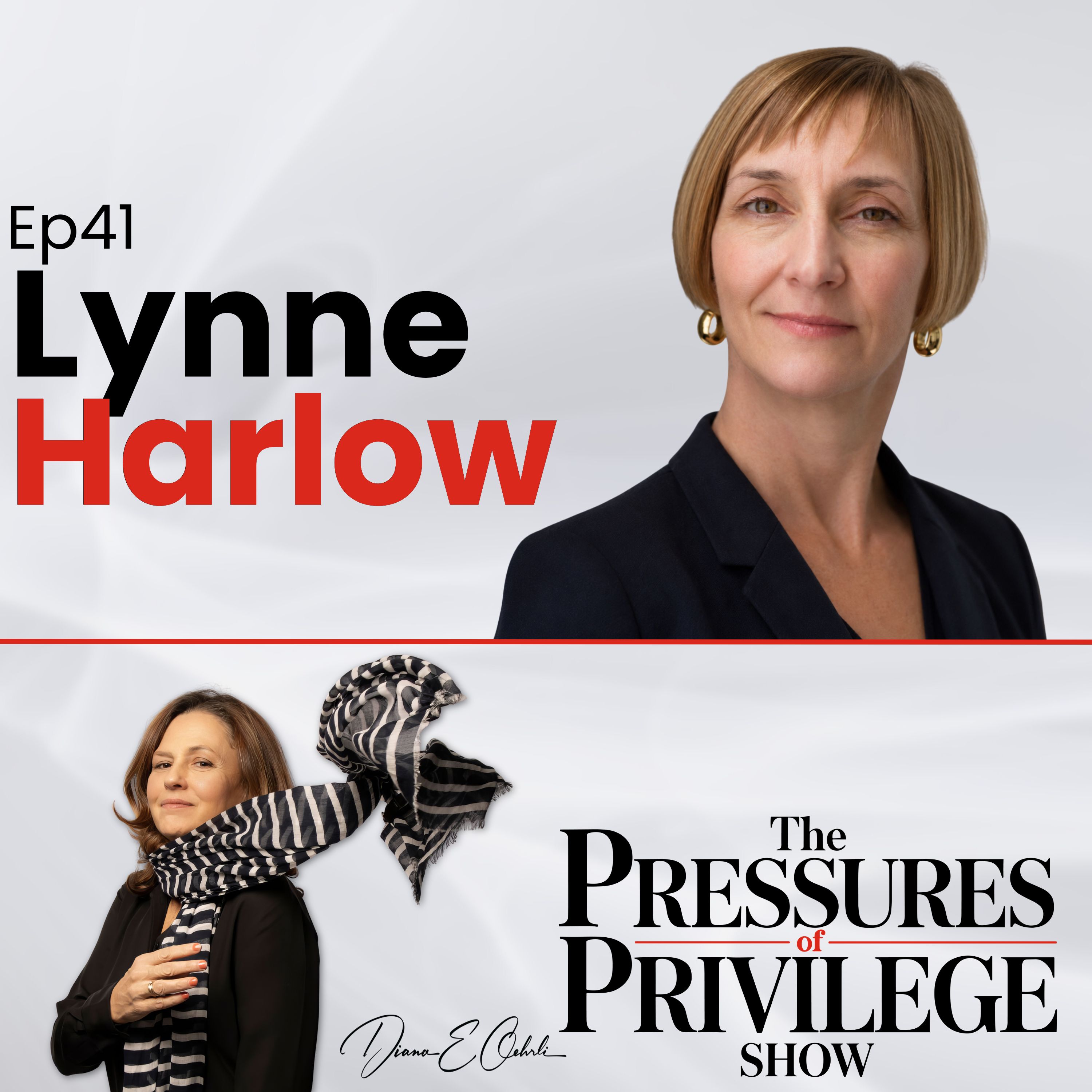
Today's guest is someone I get to work with, and I feel lucky every time we do. Lynn Harlow is my grants manager at the Grubin Charitable foundation to. Together, we review applications and direct grants to nonprofits here on Aquidnik Island. She's sharp, she's thoughtful, and she makes the work better. But here's what most people don't know about Lynn. She's been a working artist for over 25 years. Her work is in major museums, and when you look at it, you feel it.
She also runs her own firm, Tangerine Advisors, and has spent her whole career inside foundations.
For years, she managed the Lily Auchincloss foundation in New York City, giving away millions of dollars a year to groups working in art education and human services.
Today, I want to talk about all of it. The grants, the giving, and especially the art. Because Lynn once wrote something in her artist statement that I want to share. She said that taking things away from a piece is ultimately an act of generosity, that by removing more, she gives more. If I get that right, I want to know what that means in her art and in her life. Lynn, welcome.
[00:01:59] Speaker A: Well, thank you very much. I'm excited to get to talk about all of this today.
You're.
[00:02:04] Speaker B: You're such a. When I'm so lucky to have found you. I just feel that when I. When we. When I first hired you to. To bring you on to the team at. At Grubin, I. I had no idea about the. That you were an artist.
Right, right.
[00:02:18] Speaker A: You knew about my foundation background, and then the art revealed itself a little later.
[00:02:23] Speaker B: Yeah. And. And I know from the get go, I've just loved working with you. And I think it's. There's something.
Maybe it's when we talk about some of the needs on the island and some of the philosophy that's running the foundation, you seem to really get it
[00:02:39] Speaker A: like you're just, mm, I'm so interested in the work. There's no better way to really understand a community than to really know its nonprofits and understand its needs.
So it's fantastic to get to do this with you.
[00:02:56] Speaker B: Yeah. You've been doing this for 20 years and first running one and now advising many. What do you think's changed the most about how you think about giving money away?
[00:03:07] Speaker A: Whenever I'm working with a foundation or other institution that's making grants, I'm always focused on what that particular donor's mission is, because everybody approaches it a little bit differently. Right.
So I want to make sure that I'm helping support a given foundation in the way that they most want to get the money out, really want to engage with their community.
And that's one of the things that has been great about working with Ruben, to really understand why, what your intentions are. And you have refined and developed the mission and the focus of the foundation over time in ways that are so responsive to what Newport and Aquinnock island need.
So that's a perfect example of how I always like to think about working with a funder.
How do they want to have an impact?
[00:04:04] Speaker B: Oh, thank you. I like the responsive part because it's true. Things, things, you know, we can plan all we want, you know, but things happen. You know, there's. There's an expression. Yeah, make plans and God laughs.
[00:04:15] Speaker A: Right, Exactly.
[00:04:18] Speaker B: And so it's having that ability to sort of pivot and be able to go, oh, they don't need this after all. They need that.
[00:04:25] Speaker A: That's always changing. Exactly. And so if you're not tuned in and not noticing those changes, then things can become less effective over time.
[00:04:34] Speaker B: That really points to the fact that we're really trying to be responsive rather than sort of direct it, like top down. You know, this is the change we want to see in the community instead of, what do you guys need to fulfill your mission?
[00:04:48] Speaker A: Exactly. Yes.
[00:04:50] Speaker B: Okay. All right. I'm glad you like that. I think in the beginning, before you came, you know, I. The. The money that I was entrusted with or to steward and to fulfill the philanthropic, you know, mission that my great, great grandfather established.
I didn't know what I was doing, so I just took. I just copied what, you know, the. The bigger trust had been doing. Like, I went through their website and basically went, oh, they're helping people with addiction. Okay, I'm going to give them money. They've done the homework.
And then over time, I had to do. We had to do Some homework in house, and you've been helping with that. So it's been such a fun and. And fulfilling time doing this together. Because doing it alone was exhausting.
[00:05:34] Speaker A: Oh, I'm glad that this has. Has changed and. And made it more positive for you. Yeah, yeah. I mean, it was.
[00:05:40] Speaker B: There's a limit to how much they say if you. If you go alone, you can go faster, but if you go together, you can go further. Right.
[00:05:47] Speaker A: And, you know, I think even so, we're able to move pretty quickly. I don't think we're especially bogged down in process, so I feel like there's still a kind of speed in the responsiveness that we were talking about.
[00:06:00] Speaker B: I think what's cool, too, is that you're based in Providence and I'm based in Newport. Well, Newport, Austin, but you.
I think, and this is something that I experienced when I was living in Switzerland.
Being a little bit out of the place where you're funding gives you a bird's eye view. Whereas if you're in the community too much, I mean, I think it's important to spend time with the site visits.
I think we can not be able to see through the trees.
[00:06:24] Speaker A: Yeah. I think there is some value in having a little bit of that distance and that perspective, because we then get to rely on all of the really deep expertise of the organizations and the leadership that are in the community. So. So.
So that level of detail is really so thoroughly understood by them. It's perfect.
[00:06:47] Speaker B: Yeah.
So you ran a contemporary art gallery inside an airport?
[00:06:53] Speaker A: I did. I did.
About 15 years ago.
There was this push to put art in airports, which I think is so smart. I mean, there's a lot of unused space or wall space, I guess, in airports. And TF Green, in partnership with the Rhode Island State Council for the Arts, decided that we needed some artwork at the airport there, and it was a great thing to do. We showed some beautiful work by a lot of different artists based in Rhode island, so.
[00:07:29] Speaker B: Oh, so it wasn't just you. You were part of a group?
[00:07:31] Speaker A: I was part of a group, yes. So I was coordinating exhibitions by a whole range of artists, and people who were interested in having their work in that setting could buy and submit their work. It's a really cool project.
It continued for more than 10 years, I think. I don't believe it's running currently, but it was a really worthwhile thing.
[00:07:54] Speaker B: Was there a central theme?
[00:07:58] Speaker A: There was not one overarching theme, but what we would try to do is organize shows that shared either a theme or some commonality in the way people were working. So we did kind of straightforward painting shows that would feature maybe two or three artists, but then there was sculpture and all sorts of other, you know, constructed work.
There were some really amazing woodworkers who brought in big pieces that they had composed. So, yeah, it was very varied, and each show had its own really distinct character.
[00:08:32] Speaker B: It shows a little bit of the culture and the fabric of Rhode Island.
[00:08:38] Speaker A: It does.
There are so many artists here, really amazing practitioners, and so to get the chance to feature that as a really kind of key identity of the state, I think, was a nice thing.
[00:08:56] Speaker B: You helped build the Vela foundation from scratch.
[00:08:59] Speaker A: Yes, that was a fantastic experience.
The trustee of that foundation had a really strong interest in food access and nutrition, nutrition education, and she wanted to structure a formal foundation and an application process and, you know, everything that goes with that. So I worked with her for a year to make that happen. And it was a really thoughtful process because even within the world of food and nutrition, there's a huge amount of work going on.
That foundation is based in Massachusetts. Excuse me. And there's a lot of work in Massachusetts. It's related to that.
So we had to really think through what the geographic focus of the foundation would be and what aspects of food access and nutrition she really wanted to prioritize. And then there was also a lot of outreach because it was a new foundation, and people, of course, didn't know that it existed. So we did a lot to reach out to organizations and experts in. In a variety of communities in Massachusetts to. To let them know that this money was available.
Yeah, it was. It was terrific.
[00:10:16] Speaker B: It's different, like, than stepping into something that already exists. Like, there's something about starting brand new, like. Like, can you.
[00:10:24] Speaker A: What was that, like, defining. It was really the most important piece initially, because before you reach out to anybody to tell them that there's this grant opportunity, it's important to make sure you know exactly what kinds of things you want to support and encourage.
So that was a really interesting piece, and that required a lot of research on my part. So I learned so much about what was happening in Massachusetts at that time.
You know, there were. There were some challenges because, like, with any foundation, there are limited resources, so you can't fund everything. So. So trying to narrow the focus a little bit and really be precise was.
Was a huge part of it.
[00:11:05] Speaker B: So it's interesting. The minute, the beginning, you're maybe really creative and going, we could do this. We can do this. And then reality sets and you're like, oh, we got to prioritize.
[00:11:13] Speaker A: And that's the case with every funder. Right. No matter how huge the pool of money is, at some point, you do
[00:11:18] Speaker B: have limits, and we're seeing that in our work. It brings me to your art statement about taking things away. From a piece of. From a piece of art is a form of giving. Does that idea ever show up in how, you know, like in our work or in how you give. How you help funders give money away?
[00:11:37] Speaker A: I think the overlap is that it goes back to what I was mentioning a moment ago, the idea of limited resources, that. That working with a set amount of funds that are available or materials that I'm working with in the studio.
Either way, you want to think not just about how can I use these effectively, but to go beyond that and think about the ways that this limited amount of stuff can be hopefully transformative.
So not just doing kind of an adequate amount with this, but. But trying to really push it to. To its maximum effect.
[00:12:18] Speaker B: I always think that when. When you limit something and you put, you know, constraints on something, like a boundary or it. It creates a bit of tension and pressure, which in my. And this is why. This is one of the reasons I love the title of. Of this podcast. The pressure is a privilege. Because pressure can be too much, or it can be too little, or it can be just right. And. And adding constraints and boundaries to something, even if it's by taking, like. Especially by taking away, like, refining something like a sculpture, it forces you to make the thing better.
[00:12:47] Speaker A: It really does.
[00:12:49] Speaker B: Yeah.
[00:12:50] Speaker A: And. And as you're saying, there's that sweet spot, right? Like you don't want way too much pressure, then that just becomes really difficult. But.
But it's like the idea of that people talk about around having some stress in our lives, having a lot of stress is unhealthy. Having a little bit of stress is very useful because it helps us recognize that we care about certain things and that we're invested in those things.
So similarly, a little bit of limitation, a little bit of pressure, I think really does give us clarity, at least, you know, in some instances.
[00:13:27] Speaker B: Yeah, no, it helps us. You know, forcing us to prioritize is painful because I'm the kind of person who has a hard time saying no to stuff. I have a hard time throwing stuff out. Oh, I remember that time, the decluttering, the, like, getting rid of stuff.
Even in my own writing, like, I've, you know, the editing process, it's so hard. Kill your darlings, you know, yeah, yeah, it's.
[00:13:51] Speaker A: It's really challenging, but it makes it better.
And then I think of it also
[00:13:58] Speaker B: in terms of parenting. I mean, I've. From my research and some of the issues with this current generation of adolescents who are really suffering from anxiety, maybe a lack of boundaries, a lack of pressure, like putting, making, like taking. A lot of parents like to take away repercussions of their children's mistakes instead of like, okay, you, you've got a DUI now. You've gotta pay your bill, you gotta pay your fine, and you gotta do community, community service.
And you may have to go into Breathalyzer for the next two months or half a year, but I know some parents who just wanna get rid of all of the friction so that it, you know, hire the lawyer, make it easier for the kid.
[00:14:44] Speaker A: Oh, yeah, no, that, that friction is necessary. It really is. It's hard, but has meaning.
[00:14:52] Speaker B: So speaking of some of what you would love to see, like you told us you wish every funder gave general operating support instead of projects, and I would love to know why. Does that, like, explain that?
[00:15:06] Speaker A: There are certain key things that I think every funder looks for, right? You're looking for good, solid leadership, financial stability in an organization meeting the mission that they have defined for themselves.
If all of those things are in place and you're thinking about giving an organization a grant, why limit it to program support? I think if all of those, those key things are really there, trust them to use the funding in whatever way they think is going to help them meet their mission, be most effective.
I really feel like every fund should at least consider some general operating support. I see situations where I can understand a little bit of hesitation. You know, for example, if a really large, if an organization has a really large budget and a funder is making a relatively small grant, maybe in that case you do want to fund a program rather than general operating, just so you have a sense of how that, that money is being used. And I think those are really the exceptions. I think that that doesn't need to happen much.
[00:16:17] Speaker B: It speaks to trusting you trust that that organization, its mission, and it's also speaking to not micromanaging how they do their job.
[00:16:28] Speaker A: With any grantmaking, particularly general operating support, there are going to be moments, just hopefully not frequently, when a grant doesn't work out the way the funder had hoped and intended.
It's okay, you don't want to see it happening all the time, but yeah, every once in a while it's going to happen.
[00:16:49] Speaker B: How do you know When a piece of yours is finished, I don't tend
[00:16:52] Speaker A: to struggle a lot with that question the way I know other artists really do.
I usually have a pretty clear sense of what I'm trying to get at when I start a piece.
And, and very often I've done a bunch of drawings and other preliminary preparations. So, you know, I've got it kind of mapped out. Go. Going back to the idea of how little is enough, I'm really always looking for the point where I feel like a piece is doing something and maybe something kind of unexpected.
And as soon as I find that it is doing something, for lack of a better description, I stop.
And then maybe what I do is walk away for a few days, come back to it with fresh eyes and see whether or not I still feel that way or if it might need some fine tuning. There are also plenty of pieces I've made that I have finished and I have considered complete. And then I look at them again and think, yeah, they're not really doing anything. And then those are not really considered actual pieces. I kind of trash them and start again.
[00:17:59] Speaker B: Oh, wow.
[00:18:00] Speaker A: I've gotten kind of disciplined about it over time. It has become a little easier to do that.
[00:18:06] Speaker B: I love that. So you, you take things, you, you, you strip things away until you get to the point that it's doing something.
[00:18:12] Speaker A: Something that just feels a little unexpected sometimes feels like it's at the border of not even being a piece of art anymore because there's so little to it.
I really love that line, like where you're just on the edge of it not being anything. And if I can get as close to that line as possible and still feel like the piece has some vibrancy to it, that's a good place to be. Is it a feeling?
[00:18:40] Speaker B: It is.
[00:18:40] Speaker A: And it also is very often connected to kind of color related visual sensation because I do often work with vibrant color.
So if something is happening that really feels like there's an active relationship between the color and the material and then often the light and the space around it, then that seems like it's in the area where I want it to be.
[00:19:10] Speaker B: I just love the artist statement. It reminds me of martial arts and in karate.
My stante is always talking about refining, refining, refining to the. Where movement becomes so, so smooth. And so he often says, you want to do that movement in such a way that the person who's looking at it is like, wait, wait, wait, how do they do that? Like they. It's just so quick and so. And it's not quick in a way that's jarring. It's quick in a way that's the way a bird is. Is flapping their wings. It's so natural.
[00:19:47] Speaker A: And, and that. That natural aspect is the thing that prevents it from ever seeming robotic.
[00:19:53] Speaker B: Right.
[00:19:53] Speaker A: It's a completely organic thing.
[00:19:55] Speaker B: Yeah. Often he'll say, ah, that's too disjointed.
I don't see the hand. You're. This is all hand driven. It's not core driven. If you can see that, then it's. It needs to be refined more and more and more. More needs to be taken away. Those sharp edges need to be taken away.
[00:20:10] Speaker A: What a fantastic practice.
[00:20:12] Speaker B: Right?
[00:20:12] Speaker A: Because, I mean, it's, It's. There's such physicality to it, but you're also doing something that's so.
It's engaging your mind in such a direct way.
[00:20:25] Speaker B: Right.
[00:20:25] Speaker A: Like you can't separate those things.
[00:20:27] Speaker B: It's interesting when you say you take away, you're able to give.
And I think in martial arts, it's probably the same like we take away the disjointedness, we take away the kind of like artificial.
Artificialness. Because there are a lot of karate practitioners who, you know, even the top. The top top in the world, the way they. Sometimes they'll. They'll perform a kata and they'll be a little theatrical and they'll add like a weird hand movement that has no practical application except just looking cool and drives my sensei crazy. He's like, no, no, no, that's. There's absolutely no purpose to that movement. And it looks fake and there's. And it's not. It's. It's a hand movement. It's not tied to anything internal. And you can tell.
[00:21:14] Speaker A: Yeah, it's this unnecessary flourish. Exactly.
[00:21:17] Speaker B: And then drives him nuts. Like, he, he's very much into making that movement. If there's a practical application, making it as smooth as possible and making it almost like, oh, gosh, this just happened. What just happened? That looked beautiful. And you just don't. You didn't even see it.
[00:21:31] Speaker A: That kind of effortlessness is something that I love in.
In a lot of different art disciplines.
[00:21:39] Speaker B: Right.
[00:21:39] Speaker A: And martial arts, you know, when you see a dancer and they're performing and it looks effortless, we all know it's not effortless, but to create that illusion through such incredible effort and discipline, you know, it's a. It's a transformative thing. And I'm thinking about the description you were just giving of those kinds of movements and how similar that Is to the way I think about a lot of what I do in the studio. Because when you have just a few elements right, just the way your arm is moving, the way your posture needs to be, it has to be perfect because there's nowhere to hide. Right.
And similarly, like, if I'm making a piece that's a monochrome, for example, that color has to be perfect. And that color has to do exactly what I want it to do because it's the essence of the piece. So I think this idea of essence is very present in both of the things we're thinking about right now.
[00:22:46] Speaker B: Yeah.
Also in music, I know we've been doing a lot of grants towards music, not so much to art, which is. I've been waiting for you, Len, to, To suggest an art program for kids.
[00:23:00] Speaker A: I'm sure there are great ones. We'll have to take a look because
[00:23:03] Speaker B: there's such a thing as art therapy, but that's kind of shifting the subject. But I was thinking also in terms of strip, because your pieces are so minimalistic and they appear minimalistic. I mean, I'm not very good. I'm not. I wouldn't say I'm an expert in contemporary art. Like, I love, I love that piece right behind you, that circle. Every time we have a meeting, I'm always looking at that bullseye above your head.
[00:23:27] Speaker A: That is by an artist who I adore, Someone named Julian Dashber, who really just made such smart, minimal work. And, you know, I feel very lucky. I. I have work throughout my home that is made by artists I know and love. And, and, yeah, you know, that that piece behind me is so active. There is not a lot of visual information there. But, oh, it's just so great. And I love to live with it. And, and these are the sorts of things that, that I like to look at and think about when I'm approaching my own work.
[00:24:01] Speaker B: Right.
[00:24:02] Speaker A: I think about who's doing the stuff that gets me really excited.
It helps me find my way.
[00:24:07] Speaker B: I love that you fill your house with art from friends, because I do. I, I, I need. I do that too. And, and you said your favorite jobs and art events led you to people who became close friends and mentors.
[00:24:19] Speaker A: Yes.
A long time ago, I worked at the Museum of Modern Art for not that long. But that led me to meet so many fantastic friends who are still a huge part of my life today. And it led me to my work at the Lilly Auchincloss Foundation. And it just kind of meshed my two worlds in a way that is so evident in the work I do today, this combination of foundation, grant making and studio art.
[00:24:53] Speaker B: Who is one person who changed your path?
[00:24:55] Speaker A: Well, Alex Herzan, who is the president and trustee of the Lily Achenklass Foundation.
She and I have worked together now for 26 years because I've been with the foundation that long. I had managed it earlier on, and I continue to serve as a board, board member now. And she has really shaped a lot of how I think about this.
[00:25:16] Speaker B: What's funny, because I met her at that Renaissance weekend.
[00:25:19] Speaker A: I remember that after we had started working together, but so soon after, it was really right around the same time that you and I connected. So it was just such perfect fate that you and Alex got to meet there.
[00:25:35] Speaker B: Yeah, I just thought that was a God moment.
Totally.
[00:25:39] Speaker A: I agree.
[00:25:41] Speaker B: Yeah. That leads me. What does your morning routine look like?
[00:25:45] Speaker A: I have a pretty simple set of things I do in the morning.
I know a lot of people have these really thoughtful, kind of complex morning routines, and I'm always kind of in awe of that because I've never developed one.
But there are three things that I do every morning. And this. This is my one consistent thread.
When I get up, I remind myself that the two things I want to keep in mind and make sure I'm. I'm somehow using throughout the day are humor and patience.
Those are my daily reminders.
If I can be using at least one of those things, maybe both of them throughout the day. You know, that seems pretty good, pretty grounded.
I always drink green tea with mint and lemongrass. That's my. My start to the day.
And I read Heather Cox Richardson's newsletter.
[00:26:44] Speaker B: Those. More.
[00:26:45] Speaker A: The three beyond that, it can vary wildly.
[00:26:48] Speaker B: That's amazing. And I love the patience and humor. I have patience on my list of values, but humor, I love humor. Why don't I have that on my list?
[00:26:58] Speaker A: Add it to your list.
Love humor.
[00:27:01] Speaker B: I need to infuse more humor into my day. Maybe if I started my day like you do with humor or thinking about humor.
[00:27:07] Speaker A: Yeah, it's a great thing to just be aware of. And it, you know, it doesn't mean we need to be like, just busting out jokes all day long, but just to have a little bit of a sense of levity as we're dealing with things.
Pretty helpful.
[00:27:19] Speaker B: Thank you. My last guest on the podcast said it's impossible to have compassion for other people if you don't have compassion for yourself. And in our work, in this nonprofit work that we do, I think compassion does lead a lot of our decision Making.
[00:27:34] Speaker A: Oh, I think so too. And it's very heartening to see that there are so many nonprofits that approach their work with a great deal of compassion. Right. That, that's what drives a lot of the organizations that the foundation supports.
[00:27:53] Speaker B: And I love how you have patience as one of your, your morning values that you try to focus on. It's one of my, I mean, it
[00:28:00] Speaker A: doesn't mean I'm always patient by any means, but it's a good reminder to at least try.
[00:28:08] Speaker B: Has it always been that or have you, do you switch them around sometimes?
[00:28:11] Speaker A: In the time that I've been doing these morning reminders, those have been consistent. I haven't really changed them.
[00:28:17] Speaker B: Yeah. What's one thing you know now about giving or making art that you wish you'd known when you started?
In both instances,
[00:28:27] Speaker A: just knowing that you don't know everything and you don't have all of the answers is very freeing.
And especially when I was younger and in the studio, I wanted to have everything figured out. Even though I was talking a lot about experimenting and trying out new things, I wanted everything to come quickly and it just doesn't.
And, and you know, in a similar sort of way, I think you can't instantly know exactly how community works and where the best places are to make grants like that. Understanding that, that real sense of what people's needs are and how people are interacting with, interacting with each other, that builds over time. And the better you understand it, the better everything goes. So I guess it's back to patience.
[00:29:27] Speaker B: Right.
Letting go of control. Right.
[00:29:30] Speaker A: Yeah.
And we don't do that without some real thought and, and some real sense that, that we can just let go of control in any aspect of our lives. Right. We need to feel confident that whoever we're giving it over to is capable.
But yeah, as soon as you know that, then go ahead and, and, and trust whoever it is you're, you're thinking about and give up some of the control. Because ultimately I think the outcome is much better when you hand it off to somebody who, who can do whatever the given thing is with real expertise and, and real compassion.
[00:30:20] Speaker B: No, I love that. I mean, we do put in some guardrails, for example. We're required to, you know, to do the check ins to see how do they spend the money, like what they, like what did they intend, what actually happened.
And then, and then sometimes they have a good reason for, oh, we weren't able to do this, but we can do this, and it sort of still fits.
[00:30:39] Speaker A: And, and I really Respect it when there are those shifts.
Because, you know, if things don't go as planned, we don't want to be paralyzed by that.
[00:30:50] Speaker B: Right.
[00:30:51] Speaker A: In any instance, it's important to be able to shift a little bit and think about how to move forward instead. So. So, yeah. I mean, I always appreciate it when somebody is able to make those necessary decisions and make some changes.
[00:31:04] Speaker B: It's also like leaving room for them to get what they truly need or what they truly need to do. They need space to do that.
If we're micromanaging and on their backs all the time, that's not good.
[00:31:17] Speaker A: No, no, it's not good. It's not necessary, and it can really backfire.
[00:31:23] Speaker B: Have you ever, like, in terms of, like, I'm going back to your art. Have you ever, like, how little is enough? Like, how much can be taken away before a piece actually just crumbles and then you've taken too much away?
[00:31:34] Speaker A: It's the most subjective question, Right? Because in thinking about how artists work, somebody else's version of how little is enough could be a lot.
And even. Even within my own work, that limit can change a little bit.
I can make things that.
That are truly, truly minimal, barely there sometimes, maybe I want to make something that has multiple components, multiple colors. And in that instance, it answers the question of enough.
But the idea, the basic idea that.
That you can probably do with a little less and. And still come out ahead works in a lot of instances.
I mean, it's also pretty theoretical, right?
There are certain, like, you don't want to go low on the air in your tires just because you know this idea of. Of doing with less. Like, sometimes you need what you need. But playing around with that question of where that line is, I think is such an engaging question to be involved with.
[00:32:57] Speaker B: Well, other people have loved what you do. I mean, you've been shown at the Met, at MoMA, RISD Museum, even the Decordova Sculpture Park. Where was that?
[00:33:08] Speaker A: That's in Lincoln, Massachusetts. That's a beautiful place. They have a building that's a museum, but then also grounds with a fantastic sculpture park. It was so fantastic to be part of an exhibition there. That was really, really fun.
[00:33:26] Speaker B: Yeah. And you've won the artist grant from the Pollock Grasner foundation in 2020.
[00:33:31] Speaker A: It was during lockdown in April of 2020, and, you know, those were hard days. And then I got this amazing phone call that I had gotten an artist grant from Paula Krasner Foundation. So that was. That was a wonderful thing, and it really did allow me to, to make some new work, specifically working in cast glass, which is something I hadn't done before.
So that grant functioned in, in exactly the way I hoped it. It led me into some new territory and, and I was able to make some things that I was really excited about.
[00:34:06] Speaker B: And you also had a fellowship, a fellowship from the Rhode island Foundation in 2010.
[00:34:10] Speaker A: Yes, that was huge too. The McCall Johnson Fellowship is this program that the Rhode island foundation runs and it cycles through visual artists, writers, and I believe, musicians.
And they're really generous, substantial grants. And I was able to do a lot with that.
I made large scale work. I did a residency program in, in Southern Italy that also really pushed my work forward and, and it was, it was the right thing at the right time. I'm so grateful for these kinds of supports.
[00:34:49] Speaker B: You are now represented by two. Two galleries, right? Or one gallery, the Minas Space in Brooklyn and Liliana Bloch Gallery in Dallas.
[00:34:57] Speaker A: Exactly, yeah.
And I love working with both of those galleries. They are run by the most wonderful people who are so supportive and so collaborative. Yeah, it's really kind of dreamy to have the chance to do that.
[00:35:11] Speaker B: It's like minus space. Sounds like the perfect gallery for you.
[00:35:15] Speaker A: Oh, it is. Minus space is fully devoted to artists who are working in some sort of reductive approach.
And the thing that's really interesting about that is when you look at all the artists who are involved with minus space, the work varies a lot. It's not like, oh, because we're all reductive artists, it all looks the same.
That's not the case. But. But yeah, we share this approach and a kind of philosophy about the work that we're making. So it's, it's cool to be involved in a gallery that is a little more specific and has that, that focus.
And then working with Liliana, it's a broad mix of artists who are all making really smart work, but completely different kinds of things.
[00:36:02] Speaker B: How did you get into art?
[00:36:03] Speaker A: It's something that I've always had an interest in, but when I was younger, I was really drawn to art history, really interested in the history, the context.
I studied art history as well as visual art in college because I really didn't know which path I was more interested in. And it took me a while to figure out.
I was living in New York. After college, I was working at MoMA and also making art at the Art Students League, which is just a dynamite resource in the city.
And over the course of a couple years I sorted it out and decided that I really wanted to pursue the making versus the history.
And so at that point I went to grad school and got my mfa. I went to Hunter College in New York. It's a great program.
At the time they had a giant studio building over by Port Authority, which was kind of a mess, but it was great, great studio space and, and yeah, fantastic people teaching there. It was, it was a really good experience and it was, was.
It was the thing that really kind of solidified my commitment to doing this as a long term thing. So I came out of that MFA program and started making art and done it ever since.
[00:37:24] Speaker B: How is the art market changing? I'm hearing some galleries are closing in New York.
[00:37:30] Speaker A: There are a lot of gallery closures.
You know, some smaller galleries have closed, some larger galleries have cut back in terms of staff and rosters of artists that they, they work with. So there are definite shifts happening.
Art fairs over the last, what, 15 years maybe have become such a huge part of, of the art market and that landscape.
And I don't know if that's sustainable. I'm wondering and maybe hoping that they're kind of, of waning at this point.
[00:38:05] Speaker B: Yeah.
[00:38:05] Speaker A: And certainly there's more happening online because now that's possible, but there's still a lot of galleries and it's great to be able to just walk into all these different galleries, particularly in New York, and see a lot of different kinds of work. And you can just do it in this really casual way, free, of course. And I think the galleries still play a really important role in all of this.
[00:38:35] Speaker B: Yeah, I went to visit a gallery here in Newport over the weekend, the Jessica Hagan Gallery. And then.
[00:38:42] Speaker A: Oh yeah, what a great place.
[00:38:43] Speaker B: And I was with some artist friends and they said, they quoted some research that if you stand in front of a real piece of art, not a digital version, that there is a, I forget, 48% reduction in stress when you're looking at real art.
[00:39:00] Speaker A: Wow, that's pretty cool to look this
[00:39:02] Speaker B: up because this could, this could be something that, you know, Grubin could kind of. We, we could maybe fund something in that direction, but it's.
Yeah, we've known about the benefits of playing an instrument and music, but this. I didn't realize that just going to an, a museum or a gallery and standing in front of a real piece of art can actually reduce stress.
[00:39:25] Speaker A: It's an amazing thing.
[00:39:27] Speaker B: Right.
[00:39:30] Speaker A: Whether it's visual art or music, they have such a deep impact on us emotionally and physically. I would love to know more about the research around that. Because, well, I feel that way when I go to a museum. I feel great when I've looked at art for a while.
And so I like to think that that really is a benefit that, that we all would share.
[00:39:50] Speaker B: They were saying that it's not the same digitally. You are not going to get the same benefit looking at a phone or at a screen. You have to go and see actual paint or, you know, the actual live.
[00:40:02] Speaker A: The physicality of things really matters. And, and a screen is just a different interaction because, you know, it inherently involves light and a different, a different impact on our retinas. And believe me, I don't know any of the science behind that, but it's different.
[00:40:19] Speaker B: How would you say? Because I'm really interested in the topic of stewardship and the idea that we steward our families, we steward our bodies, we steward our, our craft. I was thinking about the intersection between art and health in a stewardship lens.
[00:40:37] Speaker A: Well, stewardship really is taking care of things. Yeah, you just mentioned. And, and it's, it's such a simple concept.
Anything that we care about, anything that has some value really needs to be cared for.
And also, even if it doesn't have value specifically for us, but it matters to our community, it matters more broadly. That's still something that we should really take care of even if we don't have that, that direct relationship or investment. And even though I don't find myself thinking consciously about the word stewardship on a daily basis, it's what I do every day.
[00:41:21] Speaker B: But you wouldn't be able to do all this stewarding if you weren't taking care of your body.
You'd be tired, you'd be, you might not be as motivated to do it. You might be in survival mode and not able to, to think, oh, that organization could help a bunch of thousands of people. You'd be thinking more about, oh, God, I've got a stomachache and I just, all I want to do is sleep.
[00:41:44] Speaker A: It's true. Right. However we're feeling physically really impacts our capacity to do everything else in our lives. Yeah.
[00:41:54] Speaker B: I mean, physically, it's also, it encompasses the emotional side, the spiritual side, the, the sense of purpose, the sense of connection. It's not, I, I think, you know, if you take away the body, we can't really steward these other parts either. So I do think the body encompasses all of that.
[00:42:09] Speaker A: This points directly, I think, to, to the Grubin mission.
Right. That, that we recognize the importance of, well, being in all of its aspects and trying our best to maintain these, these different parts of who we are in our lives.
It's so necessary so that we then can be effective in whatever it is we're looking to do. So whether it's family or work, I
[00:42:39] Speaker B: was just thinking of, like, before you came on, I went to that funders meeting that we go to. It's like a group of funders who get together every summer, and we talk about our, you know, our project, our favorite projects and. And giving and where. Where we think there's a need.
And I. Before you came on, I think I stood up and I said, well, I'm focusing on. On trying to help people with addiction in Newport County.
And some of the old guard went, oh, they kind of laughed me out of the room in a way. They were like, good luck. It's kind of an unsolvable problem, and we just don't see a solution to that, so forget about it. And then after the meeting, Rhode island foundation and a few others came up to me and said, diana, like, if you. We want to support any initiative that you think is worthy.
And I was thinking that that old guard, not to criticize them, but they. They didn't know anything about it. They are in that. They're in that world of we don't talk about mental illness, we don't talk about addiction. This is all very stigmatized.
And they are not going to direct grants to mental.
Mental illness recovery because they know nothing about it. And they themselves are maybe not leading the healthiest lives.
You know, so if they look in that direction. Oh, that. That's not healthy. Oh, I'm doing it every day.
And they're not. I wouldn't call them. You know, I'm not saying that they're addicts or anything like that, but, you know, they're maybe not living their best and healthiest life.
How can they give away or how can they help other people who are really struggling unless they understand that struggle themselves a little bit? Even on. On. On. On a higher level.
[00:44:27] Speaker A: This is where curiosity is. Is such an essential thing.
[00:44:31] Speaker B: Right.
[00:44:31] Speaker A: I'm sure you, as you're describing, they didn't really know about this.
[00:44:36] Speaker B: No, it was before the opioid epidemic. I remember, and I was. It was just starting. And then I remember the following year, we went in and it was like, opioid epidemic was a big deal. I'm like, well, it was a big deal even before the opiate epidemic. We had people dying and, you know, of alcohol poisoning and. And an addiction. Didn't want to talk about it.
Yeah.
[00:44:54] Speaker A: And that idea that. That you were just mentioning, you know, something that is kind of unsolvable, solvable.
I don't think that exists. I think that anything is solvable.
But it takes a lot of resources and it takes curiosity and understanding and all of that to, to understand what it is that might even, even be the most helpful way forward. So I'm glad to know that, that since that time there has been a shift.
[00:45:22] Speaker B: Right.
[00:45:22] Speaker A: And people are more open to funding these kinds of programs.
Very glad that that has happened.
[00:45:28] Speaker B: Yeah, it's been a huge change in the last 10 years, I've noticed. So do you have any sort of advice for, you know, families who might be wanting to start a philanthropic project, you know, a legacy project within their families? What would you advise them to do?
[00:45:44] Speaker A: I guess my, my first thought is definitely do it. It's. It's a really worthwhile thing that can sometimes be a little daunting. Right.
Especially if someone hasn't really done that before. It might seem like, well, it's complicated. There are a lot of steps, there are a handful of steps, but ultimately it ends up being really of huge benefit to the community.
And it also becomes a real learning opportunity for anybody who, who's doing that kind of giving.
And what's also nice, I think is for somebody who, who's thinking about getting involved with, with this kind of giving, they can be as active and as hands on as they want or take a step back and let somebody else help them with it. Right. There's, there's such a range of, of engagement. So if anybody is thinking about that, I would say go ahead and get started.
Have some general thoughts about the kinds of things that, that they might like to. Excuse me, like to support.
But you don't have to have it all figured out. You can kind of figure it out as you go.
And that's a really nice thing that happens that over time there is that evolution and you don't have to have it all mapped out on day one.
[00:47:14] Speaker B: No, I always think because in my book I'm starting to write about, well what. Because I see sort of the healing the world kind of mirroring, healing the inside and in a strain it's, it's like there's the micro and the macro. One of the exercises I've done is to write down all of my problems personally.
And that's. I had a therapist who had me do that, um, write list of everything, you know, that the problems, things that are making me upset. Like in, in, in 12 step we do a resentments list and a fear List.
And I was thinking, philanthropically, I've had actually Mike Kim, one of my coaches, said, make a list of things that drive you crazy, that you're really like, the injustices of the world. You know, I write down, like, destruction of the rainforest, blah, blah, blah. Write down all the things that I get really impassioned about, like cruelty to animals, cruelty to children, you know, abusive children. Make a huge list of that. And that kind of gives you already an area, an idea of what you might want to fix.
[00:48:14] Speaker A: That's a really great approach because there are things that we have really strong reactions to and. And that does help to. To indicate what your way forward might be in addressing that thing that drives you nuts.
[00:48:28] Speaker B: Yeah. Then my next step is you do your own lifestyle medicine assessment. Like, how are you doing with your sleep, your food, your exercise, your. Your connections? Like, you know, how are you doing on a personal level?
Because I think it's really important not to.
To forget the self. Because I think if we don't. If we give him an empty cup, you know, in Africa, there's a. There's an. There's an expression.
Beware of the man who's giving you the naked man who gives you a shirt. A lot of people love to give advice, but they're not following their own advice.
[00:49:00] Speaker A: It's true. And then the process you were just describing, that reflection and assessment of how you're doing yourself can be a little hard to. To really take that close look and be really honest with yourself. But, yeah, huge gains as a result of it.
[00:49:17] Speaker B: And then I think one of my other steps is to come up with a board of directors or advisors, and I would count you as on my board. You're, you know, you're part of my, like, the people in my. In my life that help make, you know, the purpose better. You know, we're working together on not, you know, you're. You're helping me in the philanthropic area, but it's. But also you're helping me more than that because we talk about life and about the problems in the community, but they all reflect back in our own lives. We all know somebody who's struggling. We all know, you know, artists who need support.
All right, well, I want to thank you, Lynn. So where can people find your stuff besides the two galleries? The Minas Space in Brooklyn and Lilliana Bloch Gallery in Dallas?
[00:50:02] Speaker A: Online, my work is always visible on my website, which is LynnHarlow.com and it's also visible on the websites of the two galleries that I work with.
And then I do have exhibitions from time to time. I just had a show come down in Providence last week and figuring out where the next shows are going to be, I think I might be doing a couple of projects next year, including something in Newport and with Liliana Block in Dallas.
[00:50:31] Speaker B: Yeah.
[00:50:32] Speaker A: So all those details are still to be nailed down, but it's fun to have the planning in progress.
[00:50:38] Speaker B: So. Great. And you have websites, thetangerineadvisors.com for people who are looking for advice philanthropically or Support. And Lynn Harlow.com, that's your art website. Yep.
[00:50:50] Speaker A: So between those two websites, people can find all the information about my my two lives.
Yes. Tangerine Advisors and Lynn Harlow dot com.
[00:50:58] Speaker B: Fantastic. Well, thank you so much for your time, Lynn.
[00:51:02] Speaker A: This was such a pleasure. Thank you, Diane.
[00:51:07] Speaker B: If this episode landed for you, share it with someone who might need to hear it. And if you haven't already, subscribe so you don't miss what's coming. But here's the real thing. I want you to know if you're carrying something you can't talk about, if you have every resource except someone who actually understands what wealth costs. I work one on one with people like you navigating exactly that. You can reach me@diana oehrli.com thanks for listening.