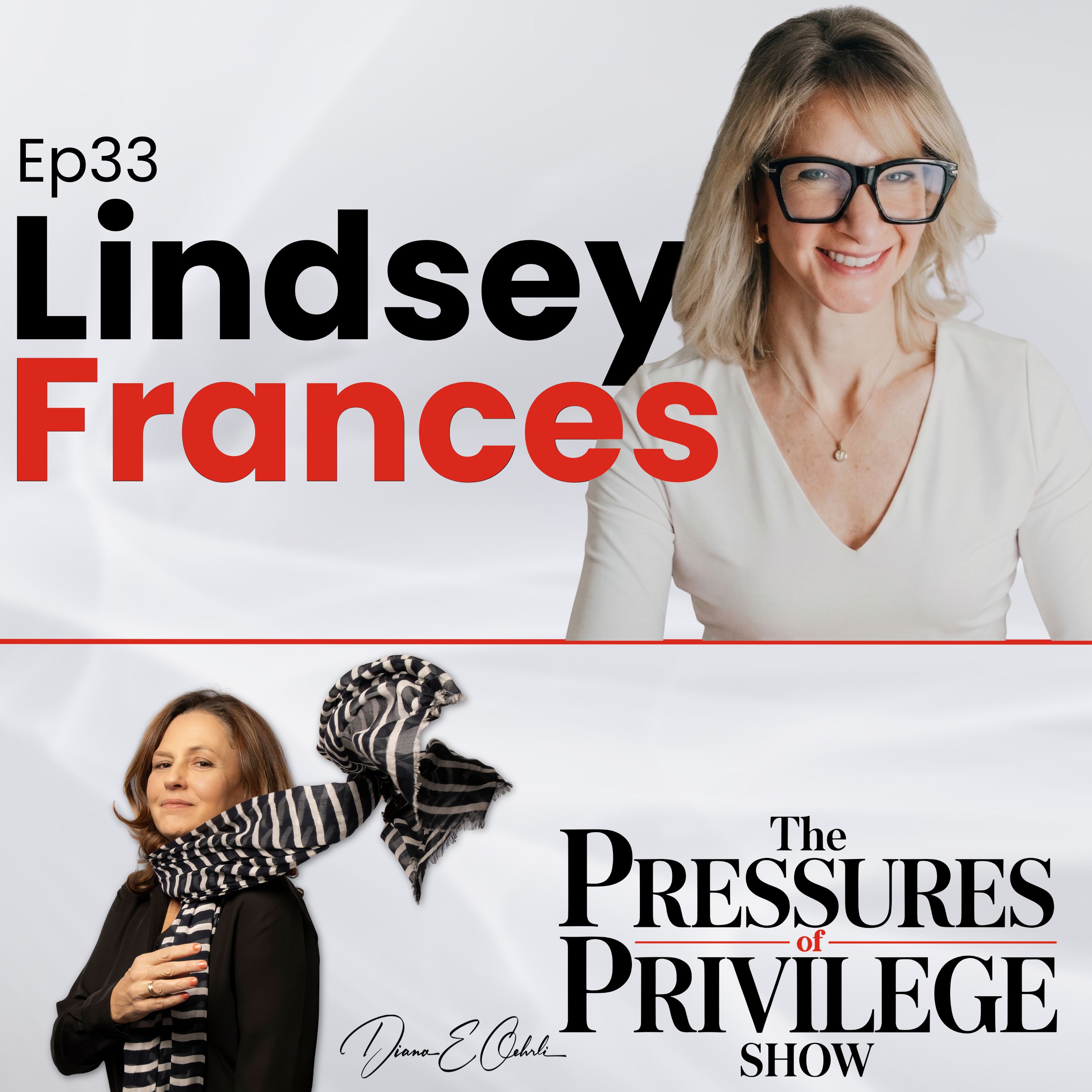
Episode Transcript
[00:00:00] Speaker A: I always invite my clients to try and code in the positive. We can still use the same energy, but we're talking about what we want. And of course, what we focus on, we move towards. So I invite anybody listening to think about, what do you actually want today? What three things do you want? How do you want to feel? Not well. I don't want to be poor, miserable, unhappy, addicted. But I want to be fulfilled.
[00:00:21] Speaker B: I'm Diana Earley, and I've spent most of my life learning firsthand what privilege actually costs and the legacy control, the family expectations, the guilt of feeling trapped in a life everyone thinks you should be grateful for. If you've ever wondered why having everything still feels like something's missing, you're in the right place.
Welcome to Pressures of Privilege.
My guest today works with some of the most successful people in the world. CEOs, investors, founders, people who have everything on paper and still feel like something is missing. Her name is Lindsay Francis. She's a legacy and wealth psychologist based in the uk.
And she asks a simple question most of us are afraid to answer honestly.
Do you actually know you have enough?
Lindsay helps high performing leaders look inward. She works across what she calls the six pillars of satisfaction. Physical, mental, emotional, spiritual, relational, and financial.
She uses biometric data. She's a midlife energy and sleep expert. Her proprietary framework is called the Conscious Change method. And her daily practice comes down to six Eat, sleep, breathe, move, recover, meditate. She'll tell you the answer is never out there. It's always on the inside. I think you're going to love this conversation. Lindsay Francis, welcome to the Pressures of Privilege.
[00:01:51] Speaker A: Thank you so much for having me, Diana.
[00:01:53] Speaker B: Oh, you're very welcome. Yeah, I'm just really excited. In case you hear any noise, there's the Boston Marathon going on right now right outside my window.
And so you might hear some cheering.
That's what that noise is.
[00:02:07] Speaker A: And I'd love people to think about how they can cheer themselves on with that cue because it's a huge thing that we forget to do, especially when we're in the space that we're talking about today.
[00:02:17] Speaker B: Ooh, I like that.
Because we do forget to cheer ourselves on, don't we?
[00:02:23] Speaker A: Absolutely.
[00:02:24] Speaker B: Is that what you see with your clients?
[00:02:27] Speaker A: Yeah. Negative self talk is a huge problem, Diana. And when we talk about legacy and inherited wealth, often it comes with some very negative responsibilities, some pressures. And the self talk that's often learned from our parents is less than enchanting. I always say to my clients, you actually speak to everybody the way you speak to yourself. So if you're speaking to yourself poorly, imagine what you're really coding out there when you go to communicate with others.
[00:02:57] Speaker B: That's amazing. You always hear, you would never speak to your friends the way you speak to yourself.
[00:03:04] Speaker A: Yeah, that's very true. But unfortunately, when we do speak to ourselves badly, we actually are thinking that, oh, of other people. So if we're highly critical of ourselves, we are also highly critical of others. And although it might not be obvious, if you do a deep dive into things like 360 degree assessments, as I do with my clients, or feedback from others, you will see that it is lurking and people do notice how they're being spoken to by you. So clean up your self talk, cheer yourself on and remember you're exactly perfect the way you are. We just need to be aware of that. Wow.
[00:03:37] Speaker B: So what you're saying is the subconscious stuff that's going on within is still going to come out subliminally and in the way you, your aura, your energy.
[00:03:46] Speaker A: Absolutely. We can't hide it, you know that from the work that you do. You can read somebody before they even open their mouths. And the reason I use biometric data tracking, as I've said to you before with the whoop and aura, is when your nervous system is really tightly wound, your HRV is low, people around you can feel it in your energy field. So be nice to yourself, try and relax into life and practice your gratitude and everything will change around you.
[00:04:13] Speaker B: Wow. It sounds easier said than done.
[00:04:17] Speaker A: Absolutely.
[00:04:20] Speaker B: So what does it actually feel like when someone finally knows they're enough going
[00:04:25] Speaker A: right to the question, oh yeah, this is the ultimate state, isn't it, of enlightenment, really? And can we actually achieve that while still, still living in the real world? My answer is yes. Course. When we really do start to honor ourselves, to build on firm foundations, as you said with the six pillars, and really understand that today is enough, that there's joy in today, tomorrow is happening anyway, but we've got a purpose here on Earth. Then the feeling of ultimate contentment and satisfaction is there in every moment. That's not to say it's sustainable, but 24 hours a day, it is a movable feast. So it's a feeling that comes and goes, but it should be coming and going really at least every hour that you're having that sense of purpose and fulfillment and satisfaction. And if anybody's a fan of Michael Singer's untethered soul, you'll know the feeling when you really are open hearted. Your nervous system is relaxed you're contented and on the data your HRV is high. That's your heart rate variability. That's signaling that you're not invited, but you're truly at peace.
[00:05:32] Speaker B: I hooked up my WUC to you, to your account about a month ago or two months ago. And I haven't really been looking at it recently. I've just been moving from New York City and Newport to Boston. And they say moving is one of the most stressful things you can do in life. And I definitely have felt that. Have you seen it in my data?
Yes.
[00:05:54] Speaker A: It's interesting you say that, Diana, because your recovery is quick. So you're on a green today. Your heart rate variability is high. Your resting heart rate is up a little bit. I'd imagine that's because you're moving and you're not perhaps doing the relaxation practices you'd like to be doing every day. But you have a very high degree of flexibility. And that's based on the fact that I am imagining or I know that you've done years and years of work on self awareness. And when we do that kind of work, it's almost like becoming elastic. We can go into these high stress environments. We can perhaps have a period where our sleep is really affected by whatever, but we can bounce back quickly. And it's the recovery time that I'm most interested in not maintaining a crazy high score every day.
But these devices are unfortunately very misleading. So just because you're on a green doesn't necessarily mean the data when we dig down is good. But I have dug into your data, Diana. I can tell you that it looks good from what I can see at my end. And I love the week because you can connect to other people. But you do a great job. So well done. I know that you're working, as I say it works if you work it, and you are working it. So well done.
[00:07:00] Speaker B: Oh, thank you. I have some other stresses in my life. You know, children, you know, we're only as happy as our, our least happy child.
[00:07:07] Speaker A: Yes, so they say. Although isn't that daily work in itself to find that what is mine and what is theirs and, and how do I not snowplow for them through life? Because of course, because we've got so much more communication. We can see where they are, we know what they're doing, we're watching their socials. My parents didn't have a clue what I was up to. And even now I can say, did you know I did such and such, you know, 30 or 40 years ago, and they'll say, no, we had no idea. And I think, well, isn't that just as well? But of course, we're. We're watching where each other are, you know, I know. I can see your data, Diana. You know, where, where I am, we're connected. We're watching each other's socials. It's not always helping us when it comes to boundaries and responsibility. You know, she.
[00:07:46] Speaker B: My daughter turned off her phone for an entire day and didn't tell me beforehand.
[00:07:51] Speaker A: And how did you feel about that?
[00:07:52] Speaker B: Oh, my mind went into catastrophic thinking. I saw her dead on the floor.
My mind goes there.
[00:07:58] Speaker A: Yes. And of course, what's important to remember is that our minds can't stop thinking about something. It can only swap thinking about something.
So I train my clients that when that does happen, and of course, we're prey animals, we do have a catastrophic thinking mechanism because that's what keeps us safe in the world. Wild. Oh, my goodness, something's happened. What do I actually want to think about? She's very happy. She's relaxed. She's gone somewhere nice. She's turned off her phone because she's busy doing something else. It's that swapping that's important. So what would you have liked to have thought she was doing, Diana? I wonder?
[00:08:29] Speaker B: Oh, working on her schoolwork. I mean, when she told me, oh, mom, I turned off my phone for the whole day. I'm like, oh, wonderful. What a great thing to do. I wish I could do that.
[00:08:38] Speaker A: Of course, I am watching my entire family's whoop schools. So when I, for example, my father, my father in law, my husband, my teens, et cetera, when I see a bad score, I'm reading, How are you? How's it going? What's, what's happening? You know, it's a level of paranoia that's totally unnecessary. And we need to really be conscious of how we respond to that kind of data because we really don't need it all the time. Oh, God.
[00:09:00] Speaker B: I'd probably be a basket case if I was tracking her whoop. Well, she doesn't have a whoop.
[00:09:03] Speaker A: Well, can you imagine? Would she actually keep it on? Is the question.
What I do track, certainly with my, my own parents, is their level of activity. Have they been moving enough? Are they doing and whatever. The biggest mystery to me was seeing sword fighting or fencing on my dad's strain. Score phoned him. I said, can I ask what you were doing today? Oh, yes. He said, I had a lovely day in the garden, trimming the hedges.
I did Wonder what he was doing up a ladder at his age. But he certainly wasn't sword fighting or fencing, he was hedge trimming. So he had a great day. I was very pleased.
[00:09:34] Speaker B: That's very, very funny. Well, at one point I did put my whoop charger in my suitcase that ended up going into storage for three days, so I wasn't able to charge it. That's my excuse. If you saw no data for a
[00:09:47] Speaker A: few days, I think sometimes it's good to take it off. And speaking about my client work, of course, when people do decide that they're going to go out and party, sometimes they will take it off and they'll also pretend it's broken or run out of batteries.
This is not my first rodeo. I've been doing this work for a long time and I know that's what happens. And there is no criticism or judgment, just being self aware that you felt ashamed about what you were about to do so you removed the device so you could do it, thinking I wouldn't see. But of course we see the gaps and then we wonder, well, I wonder what happened on those few days that they disappeared. You could say I was doing, I
[00:10:19] Speaker B: was pulling a geographical.
[00:10:22] Speaker A: Well, isn't that a thing? I'll just move and get away from my problems. And of course to remind anybody listening out there, they just come with you. So that tactic doesn't work very Paul Kabatson.
[00:10:33] Speaker B: Yes, Wherever you go, there you are. Right, it's true, yeah.
So you work with people in recovery from addictions?
[00:10:41] Speaker A: Yes, I do. It's been a really interesting journey actually, Diana, because that's not quite where my work started. My background is in leadership consultancy and I've spent a lot of time in organizational change and organizational development, more latterly in this field of legacy and wealth psychology. But with that comes addiction.
And I've had some very interesting experiences where we began to use the whoop with people that were struggling to stay in sobriety. So for relapse prevention. And that's work I now do in London with people supporting them with a level of accountability that they wouldn't normally have. It's a bit like producing data for people who are athletes, but producing data for people who are trying to recover their lives. And it works incredibly well. People love the fact that they can see information, they can see how they're doing. And for those that are neurodiverse, of course, which many, many highly successful people are, it allows us to gamify the process a little bit. So I'm an incredibly creative person. I will gamify anything I need you to do to try and get you to do it. That's something I love to do.
[00:11:58] Speaker B: So how would you gamify whoop data?
[00:12:02] Speaker A: Well, I'm constantly producing different kinds of trackers. So I might be saying to you, one day you're tracking.
Let's think, Will might produce a happiness tracker. I might be asking you to score yourself 0 to 10 across a number of categories and then adding in your HRV data. The next week, I might be asking you to focus on your physical activity. So we're going to use the resting heart rate and we're going to use the strain score, and we're perhaps going to use some sort of rate of perceived effort on walking your dog, if you have one, for example.
It's constantly finding ways to track because when we can measure it, we can manage it. But of course, people want to use different methods. It's very rare that somebody will start a journal, which I do produce. There's one on Amazon if anybody wants to use that. It's very rare that people want to stay using the same tool. They want to have some sort of dopamine hit from the need. So there's always a new exercise, there's always a new activity. Essentially, the method is always the same as you said, eat, sleep, breathe, move, recover, and meditate across those six pillars. So physical, mental, emotional, spiritual, relational and financial. And when we've got all of those in place, guess what?
We're so close to being happy. Oh, my God, that's so great.
[00:13:17] Speaker B: And how does it help specifically with people in, like, in recovery? I mean, besides that, you know. You know, in recovery we talk about halt, hungry, angry, lonely, tired. So how would a whoop score interface with something like that?
[00:13:31] Speaker A: I think that's a really good one to use, actually, the halt score, because that is when we are vulnerable, of course. And one of the biggest challenges in recovery is a routine getting the basics right. So if we've eaten three times a day, we've slept, we're already winning at life. And as we say, you know, one of the most important things you can do every day is just make your bed. It's a great start. But when we apply that in the positions people are often in where they have lots of people helping them and perhaps they're not even doing the basics. They might have somebody making the bed for them, they might have somebody walking the dog for them, they might have somebody making the breakfast for them.
So it's really nailing down the basics. Diana Eat, sleep, breathe and move. And then you've avoided the hungry, angry, lonely and tired because you've got the basics in place. You're not having this sudden moment where your energy's crashed or you found yourself in a confrontational situation you can't manage, or your cravings are out of control simply because your energy levels have dropped incredibly low. I'm simplifying this, of course, and we're talking about post detox into, well into recovery where people are beginning to rebuild a life which is substance and addiction free without creating a cross addiction, of course, to the data.
But being able to measure those people are very successful. They're very, very intelligent. They want to see, okay, what happens if I don't sleep well? I can tell you what happens. Your resting heart rate goes incredibly high. You can feel your heart jumping out of your chest. You can feel the cravings coming on. And you can feel yourself feeling really, really uncomfortable in your body, physically and emotionally. So guess what, try and get into bed. And when I can see that, and I can see exactly the time they go to sleep, I can see exactly the time they wake up.
It really is the ultimate spy tool to encouraging some somebody into a better pattern.
[00:15:20] Speaker B: That's true. The sleep and. But the loneliness, how do you measure that?
[00:15:24] Speaker A: Oh, well, that's incredibly complicated as well. If we think about the kinds of relationships we have just by being aware of who's around us is helpful. We often talk about the social battery. Who's around us that's really draining us and who's around us that's building us up. And I often ask this. When people have got large numbers of staff working with them or for them or in their home, your home should be a really safe place. And of course for some people they can barricade themselves in, in difficult times, but for other people, they're living in a home that doesn't feel like a home. It feels like a hotel staff everywhere, people coming in and out. So it's really, really important that we check the quality, quality of those relationships. Who do you actually feel is a safe person for you? Who is a comfortable person for you to be around? Who's the person that drives you absolutely crazy every time you see them? And of course, I'm not suggesting that we project our annoyance onto other people, but you know what I mean, when we know that we are always triggered by a certain person doing a certain thing, let's try and eliminate that or alleviate it. So I think the loneliness, you know, in the high net worth bracket, loneliness and really quality communities and friendships are incredibly difficult. This is why education, of course, is so important at an elite level where community building is really important and finding your peer group so you've got that equitable support.
Not easy when we talk about recovery, of course, if you've associated yourself with people that are obviously behaving in the same way as you and that breaks, you're looking really to be associating with new people a very, very challenging time. That switch.
[00:17:00] Speaker B: When I first got sober, I didn't know any sober people.
[00:17:03] Speaker A: Well, no, and sober friendships are slow. You know, it takes a long time, doesn't it? A drunken friendship is a far quicker one because you've exposed all of your inner secrets within one night.
So, yes, slow, valuable, sober friendships, what a beautiful thing to be grateful for. I love that.
[00:17:21] Speaker B: Slow, valuable friendships. That's amazing.
[00:17:25] Speaker A: Well, there's a lot of distrust also
[00:17:26] Speaker B: in the ultra high net worth population,
[00:17:29] Speaker A: of course, because you're an asset, you're a high value asset to a lot of people. And that's not a nice feeling when you know that you're really just being, I suppose, targeted, communicated or enticed because you're worth something to somebody else. And of course we see that in the advisory space with clients being passed around or clients being over delivered to. And that takes a huge amount of discernment and a lot of confidence and strong boundaries to be able to sense when that's happening, when is it genuine and when there's money going across the table, Diana, it makes the boundaries and the relationships very blurry.
[00:18:05] Speaker B: That's so hard because I know, speaking for myself, when I was living alone in Gstad and I didn't have any friends, I was very isolated in the beginning and my only friends were my cleaning. My cleaning lady for a while and. But that's not healthy.
[00:18:18] Speaker A: No, it's not. And I think that's where my desire to really encourage people to do the eat, sleep, breathe, move.
If you're moving, you're outside, you're doing something, you're more likely to meet people.
If you're going to places with the right obviously desires and intentions, you're going to meet people. But we live in a world which is governed by social media and we're the most connected we've ever been, yet the most lonely. And that's affecting every single class, category and classification of person in the western world, sadly. That's so sad.
[00:18:51] Speaker B: So how does. I mean, it's so hard to find people where there's just no financial relationship underlying It, I mean, there's some relationships that are, that are not predatory, where there's an actual clear exchange of value. Like let's say your personal trainer. You go to your personal trainer and you're paying them for a service and you end up becoming friends with your personal trainer. Is, is that necessarily bad or is that.
But is it separate to maybe a true friendship where there's absolutely no money being exchanged?
[00:19:23] Speaker A: I think I can only talk from my own experience.
And when there isn't money changing hands, it's a very different quality of relationship. Of course, we could move on to marriage and talk about that being an exchange of finances, of course, because that's even more complicated. But it is really, really hard to meet people where you are in that equitable status. And as you know, I'm involved in the international Swiss boarding school community as well. That's a great place when we're in elite education for people who are in that situation to be meeting other people, children to be meeting people with similar, we'll say similar wealth because of course it's not similar values. Values are very unique and very specific.
And when we've got many, many nationalities, third generation kids, it's a crazy melting pot. But that's a very important place, I think, for children to feel secure, safe, significant and accepted.
[00:20:20] Speaker B: You said there's a bit of a disconnect on the values in that environment. Or have you been able to find some people from your tribe?
[00:20:29] Speaker A: Family values are an interesting question, aren't they? And I think we often talk about family office values. You know, what do we stand for which is slightly different from the true values. You know, the things you notice when you go to somebody's home, the way they behave, that sixth sense of what's going on around here. It's like the fish that doesn't realise the water that they're swimming in. You often see it when you become friendly with somebody enough to be at their house or being fed by them or perhaps staying over.
I think those values are.
They're very, very complicated and I think it requires a level of self awareness first to be able to sense who's in the same classification as you.
I don't know if those words are clear enough, Diana, but how do we align ourselves with people that have the same values as us? Not just the same value in terms of wealth, that's a completely different conversation. But we have to do it by feeling and also, I think, by interest. So when we're really passionate perhaps about certain things, those passions can lead us into relationships with people who have got similar values. And I always love to ask the service question when we're in these environments, Whether it's young people, whether it's people in the 20s, 30s, 40s, or even post 50, you know, what sort of service do you think you're doing in the world, world? And that leads us into the legacy question. And people always say, well, I don't know what my purpose is. And so. Well, if we boil it down to my purpose is to discover my gifts and talents and give them away, what would you do? I don't know what my gifts and talents are. Well, that's easy. We can do an audit. It's very simple to look back on our lives, and there are many, many tools we can do to do that. Okay, so how am I going to give that uniqueness away to the world? And that's the service part. And where we can start talking about things like philanthropy, gifting and volunteering and really doing something that is so much more valuable than just investing or spending.
[00:22:28] Speaker B: Wow, that's such valuable work.
[00:22:29] Speaker A: It's incredible work. And of course, we could segue nicely into the great wealth transfer, if you're happy to now, because you know that that's on everybody's lips at the moment.
$124 trillion changing hands. Is that right? That was the latest figure. I read much of that is coming to women. How exciting. The biggest feminist movement of all time, supposedly.
So. Yes. Would you like me to expand, Diana, or where could we jump in? Because that's another fascinating topic.
[00:22:57] Speaker B: Well, how. How do you feel about this wealth transfer?
[00:23:00] Speaker A: Oh, I don't think we're talking about it enough.
It feels like it's a bit of a secret. It's a bit of a secret thing, isn't it? We're not meant to talk about money, especially the English. We never talk about money. We don't show money.
It's. I mean, in parts of Europe, you know, that there's no demonstration of wealth at all. Overtly. It's often very, very hidden away.
Less so in the Middle east and I think America, you'll have more experience of that than me. But I think the great wealth transfer is really an under discussed, incredible opportunity where people begin to think really, really carefully about, okay, this is happening. What does this mean to me? How does it affect me? And how do I then become a global change maker and actually fulfill my purpose and destiny? They're huge existential questions, Diana, aren't they? But we are beginning to see people talk about it and Then we're leading into things like purposeful investment, faith driven investing and all of the other philanthropic conversations, which of course, Sam Altman's work has started already. And we're seeing Mackenzie Scott giving vast amounts of money to charity. I think we are going to see a change.
Women give in a very different way from men. So I do think this is a very exciting time we're coming into.
[00:24:16] Speaker B: I've heard women invest differently too.
[00:24:18] Speaker A: Oh, absolutely. They've got much more of a community and servant hearted approach to investing. They aren't just looking at the return on investment, they're not just looking at the bottom line. The truth is, neither are men actually. Financial decisions are made always in the emotion and not in the mental or on paper. But we pretend that it is. It's a numbers game and it isn't. It's an intuition game, of course, because if it was a numbers game, AI would have replaced every single financial advisor and wealth manager on the planet by now. And it hasn't. So what does that tell us? It tells human factor in there. That's super important. And yes, women behave very, very differently.
[00:24:55] Speaker B: I think I've heard men are more sort of ego based and more afraid of looking bad if they made the wrong decision than women are.
[00:25:06] Speaker A: Absolutely. I think men invest from a me and women invest from a we. And if we go right the way back to evolutionary psychology, Diana, and we think about the caveman times, men are out in the field going, I'm out to get 27 deer to feed the tribe and they need to come back with 27 and be really optimistic. If they only catch 26, they'll probably get away with it. When the deer come back into the tribe, the women need to count properly and say, yes, there's 25, we have enough to feed everybody, or no, we don't go out and get some more more. You know, men are conditioned to go out, to be ambitious, to overestimate, because that's their role when they're hunter gatherers. Women have to be much, much more focused on, okay, who have I got to feed and what have I got to do? And these behaviors don't go away. You know, dogs were domesticated however many thousands of years ago, but they still behave like wild animals. We've transitioned into this new world, but our evolutionary behavior still sits in us subconsciously.
Women will always go out with an eye on the tribe and the community and how do we actually be realistic about people's needs? Men will always be over ambitious. What do we need to try and achieve here. And if we don't, it's not the end of the world. So I think they are much less risk averse from that perspective. Although the jury's out. I see some very interesting research in this area.
[00:26:18] Speaker B: In some cultures, they prepare the next generation in some very cruel ways to try to toughen them up. And I think as a mother, I have a very hard time with toughening up the next generation. I'm more of a let's give love and make the child feel that unconditional love, that they are loved no matter what they do.
[00:26:40] Speaker A: It's interesting you say that, Diana, because I had an interesting conversation the other day with some gen zers who were telling me that they think the parenting style is about to get a lot more assertive. They said, we're done with this sort of nicely, nicely easy, child led, baby led rearing type approach and we really want some boundaries now. So we're going to parent in a very different way. And I wonder if this is our generation, Diana, where we've just become child led. If you like, darling, what would you like, darling? What. What do you need from me, darling? What can I deliver? Well, of course, the reason that we're adults and they're children is because we know better.
So our job should be to provide those boundaries and that structure with an element of choice. But I do think sometimes we've gone the other way and we're so desperate for them to feel secure because perhaps we didn't, that we are overcompensating. But I think Gen Z might have something to say about parenting styles. It'll be interesting to see what happens in the next 10 years.
[00:27:32] Speaker B: Yeah, it's really interesting. Also, what about that there are many more single mothers. I, as a single mother, had a very hard time being the father and the mother in the same body, you know, being. Being this sort of tough taskmaster, but also being the.
Well, I guess I'm generalizing that the father's a taskmaster, but I think traditionally it was sort of like, oh, if you misbehave, dad's gonna come home and you're gonna get it, that kind of thing. But playing both roles in one body, I think is very difficult.
[00:28:04] Speaker A: It's incredibly complicated. You're also playing two roles for one person.
You know, you'd never be the goalkeeper and the scorer at the same time. It's a really, really hard job. And parenting isn't my area of expertise. But I've certainly watched the polarity in male and female behavior and that is a complementary dance that we do together. And in a context of parenting, when it's a man and a woman, there is a dance. There are two sides, there are two different kinds of behavior going on. And of course, in the work that I do, we talk about relationships. And of course we know that divorce is the biggest financial decision you can ever make. Which I would warn people to go out there and find some support if they are in that situation where they're thinking, this is not thriving. I'm barely surviving. Do the work, do the work, do the work because it's worth it. But you're right, it's a very, very hard time. And in fact, some statistics were given to me recently that boys of 15 are more likely to have an iPhone in their pocket than a father in the household. Isn't that a worrying statistic? That's really sad.
[00:29:13] Speaker B: Yeah, no, it's.
[00:29:15] Speaker A: So you have a.
[00:29:16] Speaker B: You have a husband?
[00:29:18] Speaker A: I do. Still. I'm doing well. I've managed to hold on, haven't let him escape yet.
[00:29:23] Speaker B: So what does it take to make that work while doing all this inner work that you find is so important?
[00:29:28] Speaker A: Well, many years ago, somebody said to me, lindsay, you do realize that when most people go this deep into the work, they're doing their own relationships for fall apart because they can see what can no longer be unseen. So, of course, I was slightly prepared for it. And you can lead a horse to water, but you can't make them drink. I'm lucky to be married to somebody who is successful and intelligent and he's so bright that he actually plays me at my own game. When I trained in the method that I use now, the French method of sophrology, I actually asked my husband if he would be part of the training cohort.
And he rolled his eyes and said, oh, I suppose if you need, you know, a guinea pig client, I'll do it. And he pretended all the way along not to really be listening.
But because he's also extremely competitive and he loves a whoop band, I've noticed that everything I taught him or showed him, he is deployed. So he's now the master of the 20 minute power nap because he knows it can get his HRV back up.
He swaps really trying to drink only at lunchtimes because it doesn't impact his data as badly if he drinks before 6 o', clock, then after 6 o'. Clock. So in terms of how this works in my relationship, if you are married to somebody who has the potential to keep up with you, I Think that's a very important first step. And then it's a bit like the dance we were talking about, the polarity and parenting. If you can find a rhythm in your relationship where you don't come into confrontation but you come into a dance, with good communication, things will always help.
I'm not saying that every marriage is going to last. I'm not saying that every marriage should last. Of course, it's a very complicated situation. But I have some plastic people actually in my clinic, which I use, and we do an observation. We do a lot of observation work in sophology, where we have two people, and then we begin to imagine that we can observe ourselves, but we begin to imagine that we can observe the scenario. And when we take a mental step back and we observe what's going on in our relationship, we can play a much better hand. So when we put our husband and wife roles together and we step back, and of course, this happens in all sorts of family therapy as well, but we use consciousness to actually step back. We physically look at ourselves, and then we look at the other person, then we can choose our next move. I always invite my clients to try and code in the positive. So we don't go into our marriage thinking, what I don't want is a divorce. We go into our marriage saying, what I do want is really strong, healthy communication. So when it's all going horribly wrong and we're shouting or something's going wrong, instead of saying, I hate, you're an idiot, you're driving me crazy, we say, I just really want healthy and strong communication with you.
We can still use the same energy, but we're talking about what we want. We're coding in the positive. And of course, what we focus on, we move towards. So I invite anybody listening to think about, what do you actually want today? What three things do you want? How do you want to feel? Not well. I don't want to be poor, miserable, unhappy, addicted, but I want to be fulfilled.
So whatever it is, Diana. But you get my point.
That's my biggest piece of advice. If you can do the work, you can check your own mindset first.
And this blaming. I've spent years blaming. It's a habit to unlearn.
Um, and I now look at myself, and I'm sure you know, with your own work, that we have to really work out what. What part did I play in this? Wow, it's.
[00:32:49] Speaker B: It sounds wonderful. Can you explain what sophrology is for some of our American listeners and viewers?
[00:32:56] Speaker A: Of course. Then there are Some sophologists in America. But this is a method that was designed by a Spanish neuropsychiatrist in the 1950s.
He was busy in a hospital in Madrid giving people electric shock therapy for mental illness. And unfortunately electric shock therapy is still used.
It's successful in treating mental illness but it also creates brain damage. So it's not a particularly robust move, but it does work for psychosis in some places. So Dr. Caicedo designed a new method. He said, this is barbaric, we can't be doing this to people. I'm going to find another way. And at the same time Joseph Pilates was also thinking about okay, how do we rehabilitate patients in their hospital beds? Caiceda was thinking, how do we really create a strong mind, body connection to live a purposeful, conscious life? And sophology actually means the study of consciousness in harmony. So Kaiseda came up with an incredible framework. There are 12 levels. It's a very, very structured method which allows us to connect the mind and the body together through breathing, gentle body movement, meditation and visualization. And would you believe Diana, it's available on prescription in France, Switzerland, Spain and many other parts of Europe, but has yet to be fully picked up in the English speaking world, America, the uk, et cetera. So I'm part of that movement. Go and find a sophrologist. There are many out there. But in the way I use it with the biometric data, we're really seeing incredible results.
[00:34:27] Speaker B: I love this mixture of, of the, of the sort of modern technology and then the more sort of holistic kind of, I would say old fashioned. I mean meditation is old fashioned and it's been around for centuries and it's, it's worked. You know it worked back in the day during the, even back to Buddha, right?
[00:34:47] Speaker A: Yeah, of course, of course.
[00:34:48] Speaker B: And I love that mixture of the two.
[00:34:50] Speaker A: It's an incredibly well documented, scientifically backed, evidence based method which works for many, many performance, anxiety, health, well being.
But when you apply it in a sort of leadership and high net worth context, you really do see incredible results.
[00:35:07] Speaker B: I also noticed that you not just gamify it but it sounds like even with your husband it sounds like you got to have fun with this.
[00:35:15] Speaker A: Well, we do now. I mean we've had to fight our way through it but I think we have to maintain a sense of humor, don't we? And we do have to not take ourselves too seriously. Of course, I'm the joker of the family, so I have got the role to play there. The jester in the court. But we can, we can play with anything if we don't take ourselves too seriously. And of course, there is a time to be serious. But, you know, let's imagine you and I have a confrontation about something. If we can actually depersonalize it. Hey, Diana, can you see how com. How much confrontation we're having about this issue? Hey, this is so interesting that you don't agree with it, and neither do I. How should we move that forwards? Not. Diana, I don't agree with you. You know, I don't want to be friends with you anymore. You're an idiot. When we, when we depersonalize it and we take a mental step back, it changes everything. And that's, that's the power of consciousness. We can be, you know, your brain can be in the present moment. You can be thinking about your feet on the floor, the backs of your legs on that chair right now, or you can be thinking about what you're having for lunch so you're in the future. Or you can think about what you said to the podcast guest last time, and you're in the past. When we can watch where our mind goes, we can play with perspective. And when our perspective changes, everything changes. Of course.
[00:36:23] Speaker B: So if we, if people could become more conscious, we might have less war, we might have less. Less societal strife.
[00:36:31] Speaker A: Well, let's not talk about the political situation going on today, but some words that come out of people's mouths, if they actually thought consciously about what they were saying, our words have real power. Do we really mean what we say? And, you know, I use a lot of words, and I've got friends that use a lot less. We do need to be really careful about what we do, what we say, how we look. And of course, it's the Freud's iceberg. You know, what's underneath the surface? Thoughts, feelings and emotions become words, actions and behavior. And if those thoughts, feelings, and emotions aren't aligned, they're not clean, they're not tidy, they're not well supported, well evidenced, and well developed, we're not aware of them. What's going to pop out to the top, above the water, Nasty words, nasty actions and nasty behaviors. So what's really going on underneath? And of course, we're seeing some of that on the political stage at the moment.
[00:37:24] Speaker B: So maybe people, instead of expressing their sadness and disappointment about things, they're maybe just expressing anger.
[00:37:30] Speaker A: I think anger is the first emotion that comes out because it's got the most energy. And of course, if we think about emotions as energy, in motion. There's always something beneath the anger. Why are we angry?
Actually, it's because I'm afraid often, well, what am I afraid of? Is that really realistic? Or again, is this me as a prey animal just thinking I might get taken out on the open plains by a wolf and we can come back and we understand our human behavior. We can really begin to understand, well, what are we doing right here, right now? And of course, that helps alleviate some of our mental angst and also helps us understand some of the mental illness as well. A little bit better.
[00:38:05] Speaker B: Yeah, that's really.
This is mind blowing. You have a line. What, you're not changing, you're choosing. Where did that come from?
[00:38:14] Speaker A: I think I might have heard that from one of my teenagers. If you're not changing it, you're choosing it.
And of course they're right. We live with this TikTok generation, and not only do my children, not only does my husband repeat back everything I say to me and use it against me, but so do my kids. So I never know who said it or where it came from, from. But we're living in a generation with more access to any information than we've ever seen before. And it's very, very interesting also what's happening in terms of spiritual seeking. Because what we're not seeing, obviously on the streets is what's happening on the Internet. We're seeing people suddenly falling into echo chambers where they're totally immersed in a spiritual experience or they've suddenly started following somebody, and let's hope it's positive, but they're suddenly totally absorbed in that kind of a community.
So we're really, really seeing these choices become very polarized and we're seeing a large range. So what is it you're choosing? I do a lot of auditing of people's days. What did you do today? Because where you spent your time is where you spent your energy, and where you spent your energy is really driving towards what matters to you. And if they said, well, I just spent today spending money, is that what matters to you? Well, no. Okay, so why don't you spend your time differently?
Because of course, we're not talking about people who don't have enough money. What happens is they simply say they don't have enough time. And that's another conversation altogether.
[00:39:33] Speaker B: I love the concept of what you're not changing, you're choosing.
It reminds. I don't know if I've said this before in the podcast, but I was a student pilot when I was 25 years old.
And we were coming into land. And when you're coming into land, you need to be lined up on the Runway. You gotta be properly lined up. And you know, before you line up for final, you need to be perpendicular so that, you know, there's always the right. You're always turning at, you know, 90 degree angles.
And at one point I knew I was off. And my instructor said, diana, are you lined up? And I was like, no, like I'm a little off. He's like, well, do something about it.
[00:40:13] Speaker A: Yelled at me. And I was like, he was right.
[00:40:16] Speaker B: I was sort of like in this kind of like lackadaisical, I'll fix it at the last minute. You know, it's only 10, 20 degrees, but you know, if something goes wrong and you're 10 to 20 degrees off and you're trying to fix a malfunction in the plane or some, some other thing you might have overlooked and you are already off, it's just going to add to the, to, to the, to the errors that could be happening and it could be life threatening.
And I just love that image. And then do something about it.
[00:40:48] Speaker A: Of course, people then say, well, I don't know what to do.
Well, at least you've started the conversation. And that's why you need to reach out to somebody who can support you with a method of your choice. But I think that's a lovely, a lovely point you've just made, Diana. You're coming into land and you're slightly off. Oh, I'll just try and fix it. It's too late. And when we don't calibrate our compass properly in terms of a direction of travel in life, of course, course, the longer we go along that one degree off of our purpose, the further away we are from really achieving what we want to achieve. So this daily recalibration, waking up in the morning, how do I want to feel today? What am I grateful for? What am I going out to look for today in my emotions? Not I'm going out to look for more money and being thinner or whatever it is, but actually I want to go out and look for joy or I want to look for awe, or I want. Or I want to look for wonder or I want to go and have a curious day. What kind of a day do you want to have? Okay, and then we'll make choices that meet that target. But it's a bit like getting in your car and not knowing where you're going, Diana. You'll get to the first roundabout and just drive around and Round and round and round because you don't know where you're going, you don't know what signpost to follow.
[00:41:51] Speaker B: So you work mostly with men and as a woman, what do you see in them that they can't see in themselves?
[00:41:56] Speaker A: Yeah, that's such an interesting point that you raise. I do work mostly with men because men really like data.
So my work wasn't intentionally designed for men. But because I like to track the data and I like to look at the metrics, it really does appeal to men. It also means they don't need to talk about their feelings so much because I can say to them, it's interesting you didn't go to bed until 3 o' clock this morning. What happened? Well, I had a massive row with my wife. Or your HRV is very, very low and you tell me you weren't drinking this week. What's happened? So we can get straight to the root cause, we don't have to faff around in the chit chat, which appeals to men. So what do I notice about men?
Well, I think men are quite direct and they often tell the truth.
When it's a woman talking to a man, a female coaching a male, I think you can be a little bit more gentle and a bit more encouraging. There's no need for me to be harsh with my clients. They're harsh enough on themselves actually and often they've been parented in quite a harsh way or perhaps not parented at all. So there's no boundaries there.
So there's that reparenting work going on at the same time. But I think that feminine perspective, that positive loving, open, community minded service approach is what's important in purpose and legacy work. What is the legacy you want to leave behind? What mark do you want to leave on the earth? What is it you want to do that makes the world a different place than when you came into it? And when we start asking those questions, we're not talking about key performance, performance indicators, return on investment or, you know, net wealth, we're talking about something far softer. So I suppose that's where it helps, that it is sometimes a male and female dynamic in that relationship.
[00:43:37] Speaker B: Yeah. Because what does a, what does a client mean when they say they want to leave a legacy?
[00:43:41] Speaker A: Well, everybody spends all their time thinking about tax. I think this is the biggest conversation I have, especially being based between the UK and Switzerland. I spend a lot of time talking to people about their tax when they don't actually need the money. So it's a mystery, isn't It. When you actually ask the question politely, what is it you're trying to achieve here? Well, I'm leaving a legacy behind.
Right, so you're amassing wealth because you want to leave it to who? For what? Future generations.
Great.
To do what?
And that's, of course, where the work starts. Because we don't want to lose our money, we want to keep it. We've got a hunter gatherer mentality, haven't we?
We are essentially squirrels storing up money for a rainy day. But the reality here is you've got enough for a million rainy days. And I was talking recently about your financial finish line. Have you met it? Okay, if you have, you've got enough money now, will your money last as long as you will? Yes. So then what are you doing with the surplus? Oh, and then when we code that in from a mentality of abundance and overflow, we begin to see the difference that we can make.
But there's an unpicking of a conversation there, because there's a subconscious default just to. More, more, more, more, more. Store, store, store, store, store. Protect, protect, protect. That's human behavior. For what? You'll be dead.
Oh, it's for my children.
They'll be 70. They don't care. It's for my grandchildren. Really? Is that really what we're trying to do here? Or is this about a bigger purpose? And this is where the great wealth transfer will become very interesting. With women at the helm of. Of more dollars and pounds, we're going to see changes in conversation. We're going to see big changes in what people actually want to do with their cash. Because you will be dead. It is inevitable everybody listening to this podcast will die.
So when we work back from that, what is it we're trying to achieve?
[00:45:34] Speaker B: Well, there's some people who. There's a book called Die with Zero.
[00:45:37] Speaker A: Oh, yes, that's another conversation altogether, isn't it? And that's when we talk about, I don't want my children to be privileged or entitled. Well, guess what? They already are.
So what are you going to do? Just be mean to them?
That's a very strange mentality sometimes, Daniel, and I'm sure you've seen that played out badly.
[00:45:53] Speaker B: Or there's the sort of the Warren Buffet. I'm just giving them 10 million or I forget what he gave his children. The rest goes to charity.
Not. Not knowing that inflation might actually not be the 10 million that it was 20 years ago.
[00:46:07] Speaker A: No. Or the tax regime in whichever place you hold, you hold citizenship suddenly changes.
It's a bigger conversation. I think the most important thing here is that people are understanding who is in that family office, what gifts and talents have they got, how do they want to give that away, and what money do they need to do that? And I think that's where the legacy piece comes. If you're being handed a business which is actually a millstone around your neck, you're being told to steward wealth. And you're a creative, you're a neurodiverse. That's very, very complicated.
Stewardship is a very contracting, kind of restrictive behavior steward, whereas creating is a far more abundant mindset. You see the difference?
I think if we have those communication in family office early on, we have some really wild conversations about, okay, what does that look like? Who's here? What gifts and talents have they got? What was the original purpose? Where did it come from? Do we understand the lineage? Do we understand the ancestral lines? Do we understand what was the original motivation for this wealth creation? And what do we want to do it do with it? And how do we become global game changers, generation 1, 2, 3, 4, 5, and down the line. They're exciting conversations, but of course, your wealth advisor doesn't want to talk to you about that. They want to talk to you about your wealth planning and where you're investing, which I find terribly boring.
[00:47:23] Speaker B: Wow. Thank you so much, Lindsay. This is wonderful. Is there anything else? You have a wonderful podcast call.
I do, yes. The rich, simple human.
[00:47:34] Speaker A: Absolutely. You can find me anywhere. Rich, simple human. Lindsay Francis. I love a podcast. I'm delighted to be on yours, Diana. It's so much more relaxing than being in the driving seat like you are.
So, yes, I do host my own podcast. I'm always open to guest pitches. I love talking about all things legacy and wealth creation. I work one to one and in groups with individuals and family offices and of course, in that slightly spicier space of recovery and addiction. So if anyone wants to stop in private, I'd love to have those conversations too. Because your purpose is, of course, finding your gifts and talents and giving them away. Sounds so simple.
[00:48:12] Speaker B: Wow, you're fantastic. I am so excited. I want to do this again. I want to. I want to keep talking about all these topics that we sort of touched on very lightly.
[00:48:22] Speaker A: Absolutely. I'd love to, Diana. It's been great to see you today.
[00:48:24] Speaker B: You too. And hopefully I'll see you in Switzerland maybe. That'll be fun.
[00:48:29] Speaker A: That would be wonderful. Take care.
[00:48:30] Speaker B: All right, take care.
If this episode landed for you, share it with someone who might need to hear it.
[00:48:39] Speaker A: And if you haven't already, subscribe so
[00:48:41] Speaker B: you don't miss what's coming. But here's the real thing. I want you to know if you're carrying something you can't touch, talk about if you have every resource except someone who actually understands what wealth costs. I work one on one with people like you navigating exactly that. You can reach me@diana oehrli.com thanks for listening.